
Most pages selling a service in a place start by calling it special. This one starts by calling it large.
A former city, not a neighbourhood
Surveyed as Township B in 1792, settled first by Braddish Billings, whose name Billings Bridge still carries. Gloucester Township from 1850, named for Prince William Frederick, Duke of Gloucester and Edinburgh. City of Gloucester from 1981, and no municipality at all since 2001-01-01, leaving a geographic name and Ward 10, Gloucester-Southgate. The boundary covers 298.5 square kilometres, from the Rideau River across the airport lands out past Mer Bleue Bog, holding Beacon Hill, Cyrville, Carson Grove, Pineview, Blossom Park, Blackburn Hamlet, Riverside South, Findlay Creek, and Convent Glen and Chapel Hill in western Orleans, plus a long stretch of Greenbelt with no housing on it. So there is no single Gloucester housing stock and no single answer on servicing. Our service areas page treats the rest of the city the same way.
Two build eras, two opposite jobs
Gloucester went from 37,154 people in 1971 to 72,859 in 1981, which is why so much of the stock reads as one build era. Blackburn Hamlet is the clearest case, roughly 80 per cent of it built between 1961 and 1980. Beacon Hill is described as primarily residential and built through the 1960s and 1970s, with Campeau and Minto the two builders named in local records and most Minto houses in Beacon Hill North dated 1968 to 1978. We flag that builder detail as indicative rather than authoritative, because a local history blog is the only source we found. Riverside South and Findlay Creek are the other end of the map, overwhelmingly post-2000. The older half means an existing footprint, fifty years of grade movement, and roots where you wanted footings. The newer half means an empty yard and a builder’s back step a metre up. Health Canada also places homes built 1960 to 1990 in a middle tier for lead-based paint, worth raising before anyone cuts into an old attached structure.
Leda clay, and why footings come first
Canadian Geotechnical Research Site No. 1 was established in 1954, in Gloucester, specifically to study soft and highly sensitive Leda clay, the sediment the Champlain Sea left behind, on roughly 22 metres of leached marine sediment over glacial till and limestone. The soil condition that most affects footings in east Ottawa is studied at a national research site inside this boundary. For a deck that means bearing and settlement: footings have to reach past frost onto something that will hold, and the depth that satisfies one lot will not always satisfy the one next door. For interlock it moves the budget, because a patio that heaves after two winters is nearly always a base problem wearing a stone finish. We are builders, not a geotechnical firm, so we dig and design to what is there. See how we build interlock patios and driveways and the deck materials we work in.
The rules that apply on your street
One City of Ottawa permit process covers all of it since 2001. The City states three deck triggers: attached or adjacent to the house, a permit if the walking surface is more than 600 mm above adjacent grade whatever the area; providing principal access to a building, a permit regardless; freestanding in the yard, a permit if it is both over 10 square metres and more than 600 mm up. Where mid-century back doors sit high above a falling yard, that 600 mm line is crossed more often than people expect. Fences run on By-law 2003-462, consolidated to 2018-05-09: one metre in a front yard, 213 centimetres elsewhere, height taken from the higher grade where the two sides differ, and nothing above 75 centimetres inside the visibility triangle measured two metres along the driveway and the lot line. That by-law names the City of Gloucester among the old municipalities it replaced and repeals parts of Gloucester By-law No. 81 of 1998, on fence and retaining wall heights, while sections 23 and 24 preserve fences lawfully erected under those old rules. Read our permit guide or see what our fence contractors build in fencing.
Water splits it too, across two conservation authorities. The east drains through the Bear Brook watershed, 488 square kilometres across Ottawa and Prescott-Russell, which the City retained South Nation Conservation to study; the Rideau side falls to the Rideau Valley Conservation Authority. Since 2024-04-01 both administer Ontario Regulation 41/24, which lists site grading and the placing, dumping or removal of fill among regulated activities, a fair description of excavating for a patio, and where it applies their permission comes before the municipal building permit. Servicing splits the same way, and on septic the footings have to clear the bed. The Rideau Valley authority states that it and the Mississippi Valley authority administer Part 8 of the Building Code, sewage approvals, for several municipalities including Ottawa.
Sources, all checked 2026-08-09: City of Ottawa deck permits, Fence By-law 2003-462, South Nation Conservation, Rideau Valley Conservation Authority.
About the photos on this page
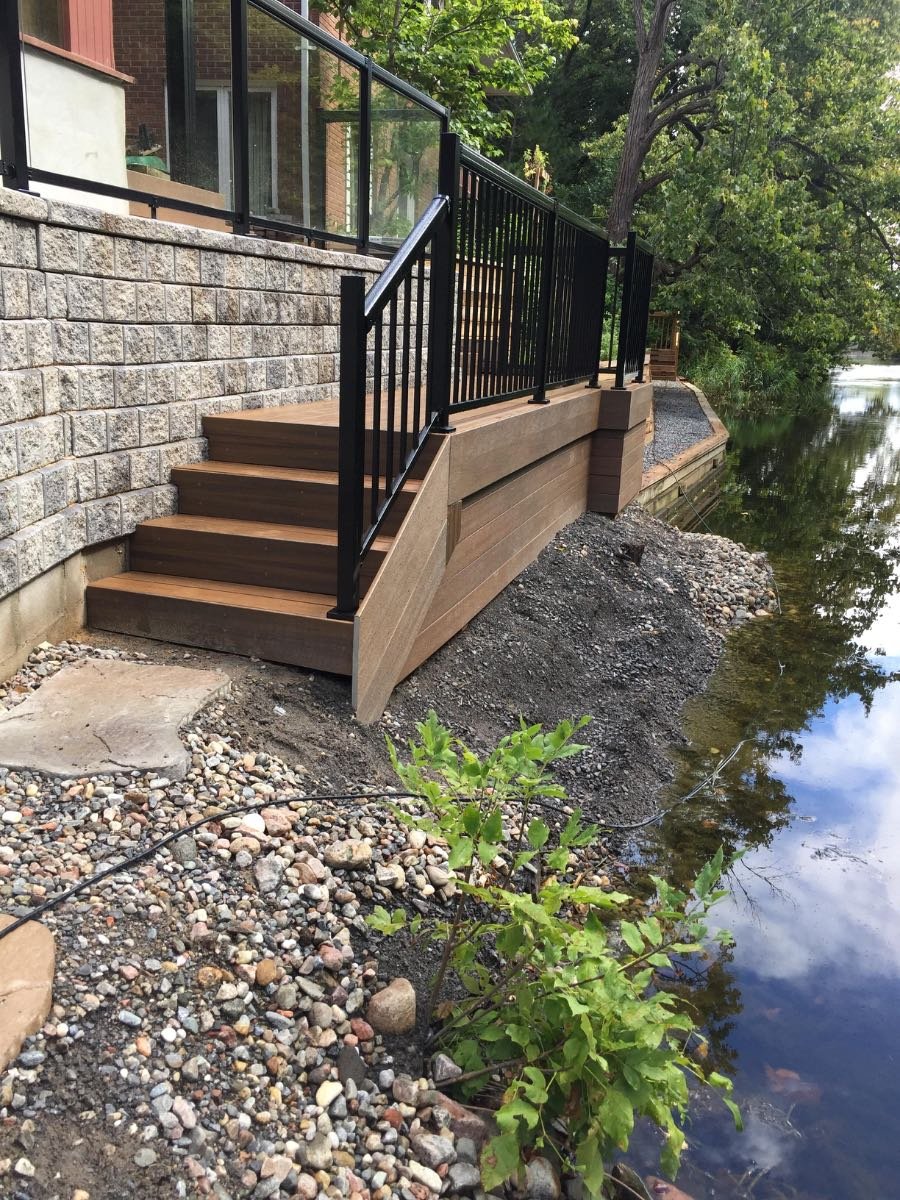
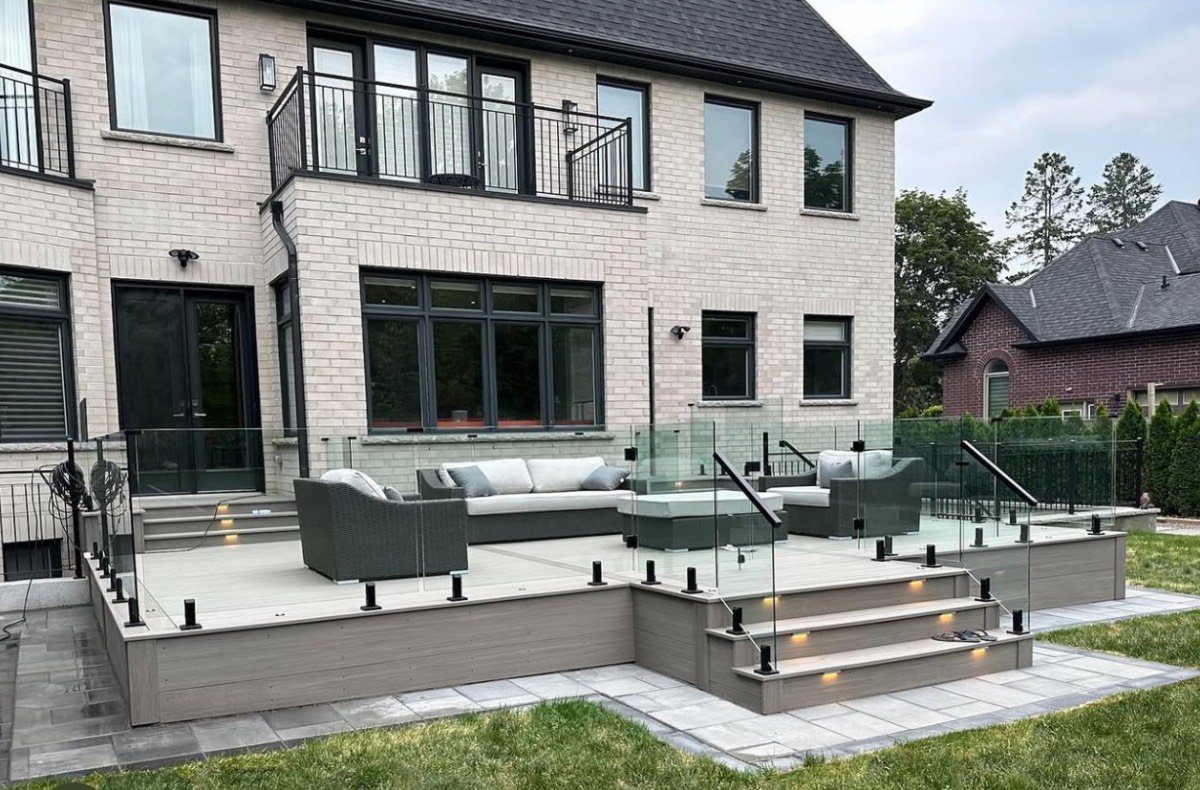
None of these images are labelled as Gloucester work, because our gallery is filed by type of build rather than by neighbourhood. We could put one of these decks in Beacon Hill in a caption and you would have no way to check it, so we do not. What is real is the gallery of work we have finished. Once projects are tagged by location, verified Gloucester photos replace this note.