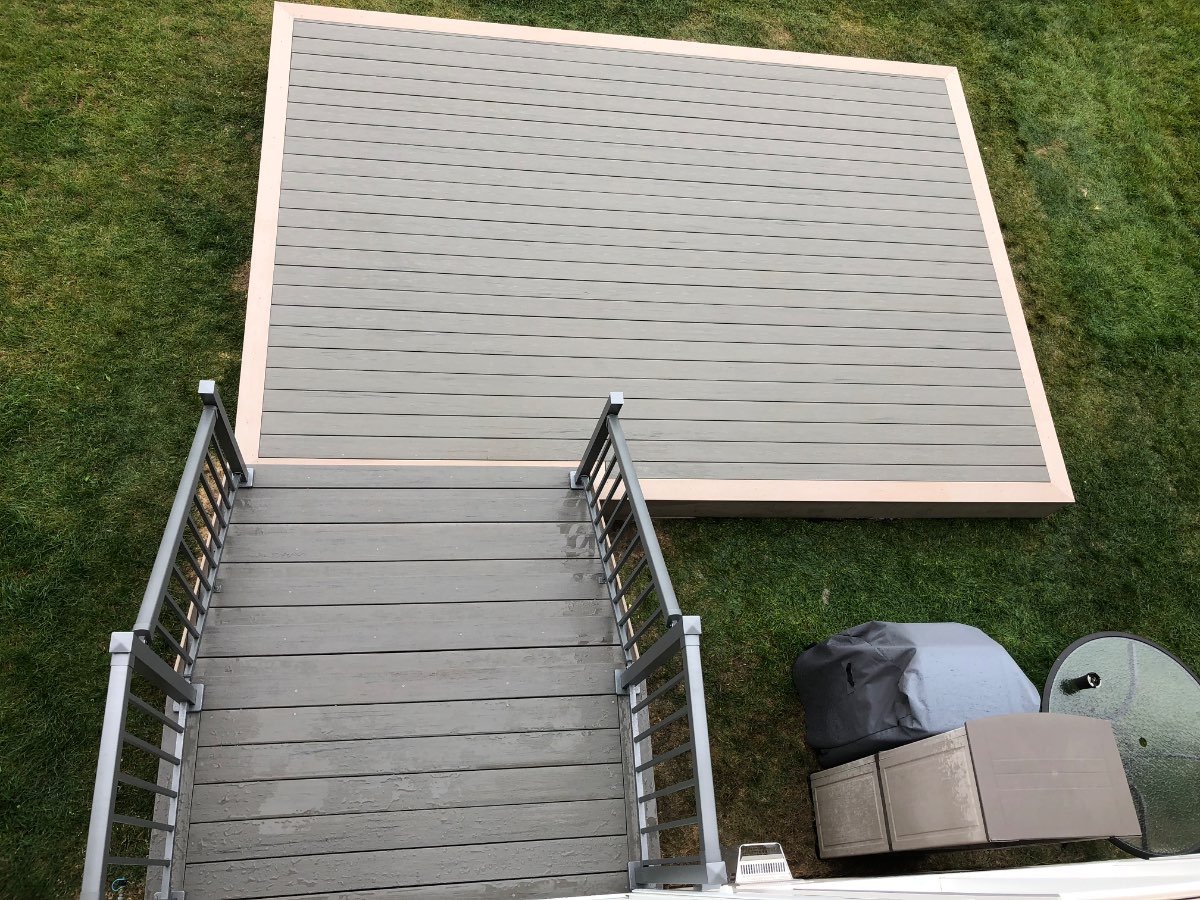

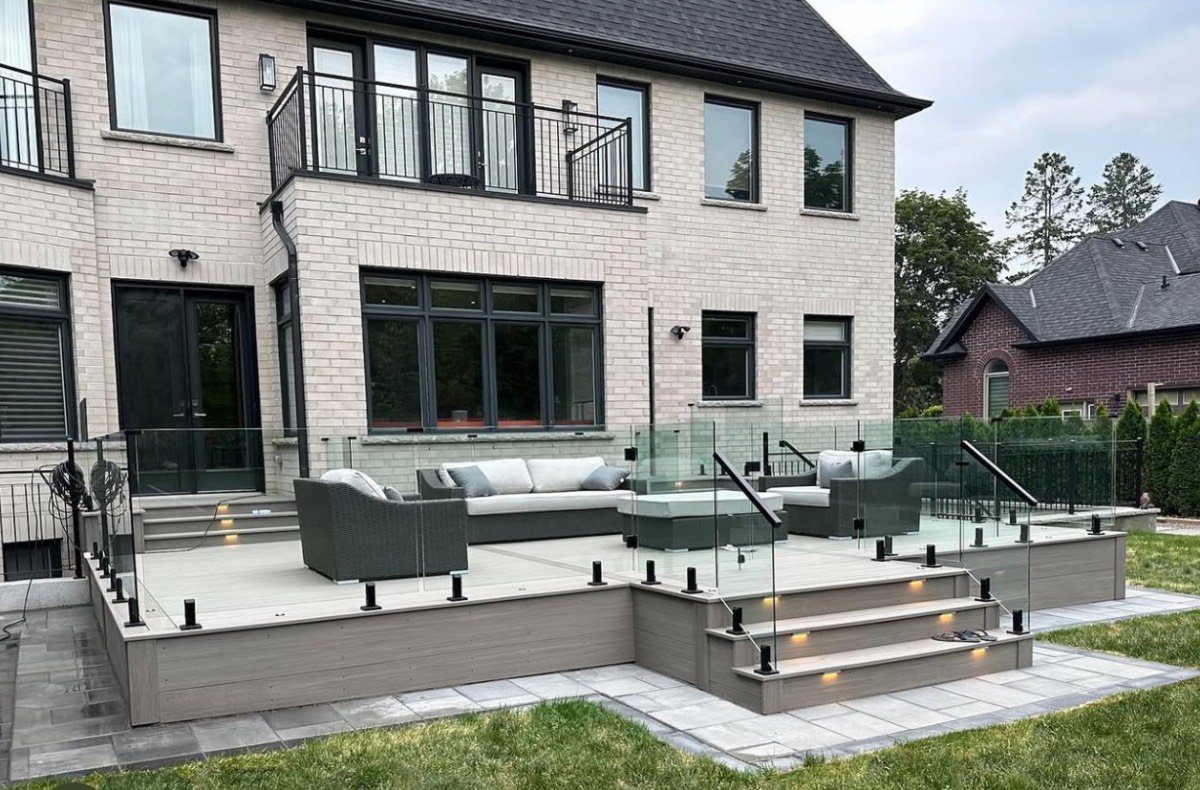
Two things about composite are specific to this climate and almost nobody mentions them: it demands tighter joist spacing than wood, and the gap we leave between board ends depends on how cold it is the day we install them. Both are covered below.
Ottawa Decking Solutions is a licensed, insured, family-owned Ottawa contractor, established 2016, and every project is modelled in 3D and AutoCAD before a board is cut. We build decks in Ottawa in composite, cedar, pressure-treated and PVC, and this page covers the first of those.
What composite actually does through an Ottawa winter
The selling line on composite is “low maintenance”, which is true and also the least interesting thing about it. What matters here is how the material behaves when the temperature crosses zero over and over.
Wood takes on water, freezes, expands, and comes apart from the inside. That is the whole story behind a checked, cupped, splintering pressure-treated deck at year eight. Composite does not absorb water the same way, because the wood fibre in it is encapsulated in plastic and the board is wrapped in a shell. So the freeze-thaw failure mode that ages a wood deck does not apply.
Composite has a different one. It expands and contracts with heat rather than moisture. That is a smaller movement and a predictable one, and it is handled at installation rather than with maintenance. It is also why the gapping section below exists.
This matters more every year, not less. The City of Ottawa’s own climate resiliency work projects that winter freeze events will increase by 33 per cent by the 2050s, because winter temperatures will sit around zero more often than they used to. A material whose weakness is moisture cycling is on the wrong side of that trend. A material whose weakness is a summer afternoon is not.
The framing decides whether a composite deck works
This is the part that separates a composite deck still lying flat in ten years from one that feels springy by the second summer, and it is decided before the first board is delivered.
Composite boards are less stiff than the equivalent piece of lumber, so the frame under them has to be tighter. The manufacturers are specific:
| Board run | Maximum joist spacing, on centre |
|---|---|
| Straight, 90 degrees to the joists | 16 inches |
| At 30 degrees | 14 inches |
| Diagonal, 45 degrees | 12 inches |
| Stair treads | 12 inches or less |
| Commercial use | 12 inches |
Those figures are TimberTech’s, from its own installation guide. Trex publishes the same 16 inch maximum and the same 12 inch requirement for diagonal installation. TimberTech adds that spacing “should never exceed 16 inches on center” and that 12 inches may be preferred for a more rigid feel.
Here is the trap, and it is a common one in Ottawa.A homeowner has a fifteen year old pressure-treated deck. The frame looks fine, the boards are finished. The obvious move is to pull the old boards and screw composite down on the existing joists. Except that deck was very likely framed at 24 inches on centre, which was normal for 5/4 pressure-treated, and 24 inches sits outside every composite manufacturer’s spec. Board over it anyway and you get a deck that deflects underfoot, voids the board warranty, and reads as a cheap job the first time somebody walks across it.
The fix is not complicated. Trex’s own guidance is to add one new joist between each existing joist, which takes 24 inch spacing to 12. It is real work and it costs real money, and it is better to know before you buy the boards than after. When we quote a re-board we measure the existing frame first, and if it will not take composite we say so.
Three more things the same guides specify that get skipped:
- The deck should slope 1/2 inch for every 8 feet away from the house so meltwater runs off rather than sitting on the boards.
- Composite should not be installed where air cannot move under it. On-grade and roof installations need a sleeper system of at least 1-1/2 inches, and on-grade decks need separate provision for drainage underneath. In a city where snow sits on a deck for four months, a board with no airflow beneath it is a mildew problem you built in on purpose.
- In climates with extreme temperature cycles, TimberTech recommends limiting board length and avoiding fixing boards to the rigid length of a joist in picture-frame or parting-board details, because that is where movement turns into screw shear. Ottawa is squarely one of those climates.
Read the source: TimberTech PRO, EDGE and Specialty Decking Installation Guide, PDF and Trex: how to space and install deck joists.
The gap between the boards depends on the day we install them
This is the most Ottawa-specific fact about composite decking, and it appears on none of the pages currently ranking for this search.
Composite moves with temperature. So the gap left where two board ends meet is not a fixed number, it is a function of how warm the board is when it goes down. TimberTech publishes the table:
| Air temperature at installation | Required butt joint gap |
|---|---|
| 32 F and below, meaning 0 C and below | 3/16 inch |
| 33 F to 74 F, about 1 C to 23 C | 1/8 inch |
| 75 F and above, about 24 C and above | 1/32 inch |
Side to side, boards get a minimum of 1/8 inch and a maximum of 3/16 inch, and a minimum of 3/16 inch is left wherever the boarding meets a post or an adjoining structure.
Now put that against an Ottawa build calendar. A deck framed in early April can easily be boarded on a morning below freezing. The same crew in late July is working at 30 degrees. Those two jobs need butt gaps six times apart. Install at 3/16 inch in July and the deck has visible gaps you will notice every day. Install at 1/32 inch in April and the boards have nowhere to go when they warm up in June.
TimberTech also warns about the in-between case, which is the one that catches people. Cut boards on a hot afternoon, leave them outside overnight in cool air, install them the next morning, and they will have contracted. Its advice is to fasten boards as soon after cutting as possible.
None of this is exotic. It is the difference between a crew that reads the installation guide for the specific board and a crew that gaps everything the same way regardless of the month.
Road salt, snow shovels, and the honest limits of “maintenance free”
Composite is sold as maintenance free. It is close, it is not literally true, and the gap between those two things is worth four paragraphs.
On ice melt.Trex states plainly that “calcium chloride or rock salt, available in many home centers, will melt ice on Trex decking”, and asks that it be rinsed off when first practical. TimberTech says most products containing calcium chloride can be used without damaging the surface, and notes they may leave a white residue that comes off with normal cleaning. So salt near an Ottawa back door is not a reason to avoid composite. It is a reason to hose the deck down in April.
On shovels.Both manufacturers are blunt about this, and it is the most common way a new composite deck gets damaged in its first winter. Trex: “NEVER use a metal snow shovel on Trex decking”, adding that a shovel may scratch the deck and that scratch is not covered under warranty. TimberTech says metal shovels, and plastic shovels with a metal leading edge, are not recommended. Use a plastic shovel or a broom.
On heat. Composite gets hot in direct sun, and the darker the colour the hotter it feels. TimberTech says so in its own literature. If the deck is a barefoot poolside surface in full afternoon sun, that is a real argument for a lighter colour or for PVC.
Source: Trex care and cleaning.
Composite against cedar, pressure-treated and PVC
We build all four and we do not have a house favourite. Here is the comparison as properties rather than as sales copy.
| Composite | Cedar | Pressure-treated | PVC | |
|---|---|---|---|---|
| What it is | Wood fibre and recycled plastic under a capped shell | Solid western red cedar | Softwood, chemically treated | All plastic, no wood content |
| Installed cost per sq ft, 2026 published Canadian range | $100 to $130 | $60 to $90 | $35 to $60 | $100 to $130 |
| Yearly upkeep | Wash a couple of times a year | Re-oil every couple of seasons, or let it silver | Clean and re-stain every couple of years | Wash a couple of times a year |
| Board warranty from the manufacturer | 25 to 50 years by line | Not offered in this form. It is lumber | Not offered in this form. Treatment warranties vary by mill | Up to lifetime on some lines |
| Joist spacing it demands | 16 in. max, 12 in. on a 45 degree run | Conventional framing | Conventional framing | Tight, same order as composite. Follow the line’s guide |
| Feel underfoot in full sun | Warm. Dark colours warmest | Coolest and smoothest of the four | Middle | Warm, but the most fade-resistant |
| Where it wins | A wood look with near-zero upkeep, on a deck that gets used hard | Warmth underfoot, and site-cut detail on awkward angles | Lowest entry price, easy to extend later | Poolside, damp low ground, full afternoon sun |
| Where it loses | Costs more up front, and it will not go on an old 24 in. frame | Wants refinishing on a cycle | Wants refinishing most often, shortest life | Reads a touch more manufactured than the best composites |
Cost figures are the published 2026 Canadian ranges cited across this site, not a quote from us.
Compare in more detail: cedar decks, pressure-treated decks and PVC decks each have their own page, and our brand-by-brand guide to Trex, Fiberon, TimberTech and Azek covers which composite line to pick once you have settled on the material.
What the composite warranties actually say
Every brand leads with a big number. The numbers are real, and they are narrower than they sound.
| Line | Residential board warranty | Fade and stain |
|---|---|---|
| Trex Transcend | 50 years, limited | 50 years, limited |
| TimberTech composite, Legacy, Reserve, Terrain | 25 to 30 years, limited | 25 to 30 years, limited |
| TimberTech Advanced PVC, AZEK | Limited lifetime | 50 or 35 years by collection |
| Fiberon Sanctuary | 40 years | 40 years |
| Fiberon Good Life, Escapes | 30 years | 30 years |
| Fiberon Concordia | Lifetime | 50 years |
Three things to know before that table does any work for you.
- The fade and stain warranty covers the walking surface. Trex states its warranty excludes fading or staining that is not on the walking surface, meaning the underside and the board ends, and excludes staining from substances other than food and drink.
- No board is fade proof. Trex says this in its own warranty language. The warranty limits how much, it does not promise none.
- The manufacturer warrants the board. Nobody but your builder warrants the deck. Footings, framing, joist spacing, flashing and fasteners are not the board maker’s problem, and a frame built outside spec can void the board warranty as well. Ottawa Decking Solutions puts a workmanship warranty in writing on every build.
Sources: Trex Transcend, TimberTech warranty information, Fiberon warranty.
When to book a composite deck in Ottawa
Composite has a wider installation window than wood staining does, because nothing has to cure. There is no minimum temperature for setting a board the way there is for a finish. What governs the season here is the ground, not the boards.
Footings have to go below the frost line, and that is a digging question. Frozen ground in January and February is the real constraint, along with the spring stretch when the ground is saturated and equipment does more damage than good. From there the season runs through to late autumn.
The practical advice is unglamorous. The crews that build in this city fill up from spring onward, so a deck you want to use in July is a conversation that should already have happened. Design, material selection and, where one is needed, the permit application all happen before anyone digs.
How much does a composite deck cost in Ottawa?
Published 2026 Canadian ranges put installed composite at roughly $100 to $130 per square foot. Applied to the deck sizes people actually search for, that arithmetic looks like this:
| Deck size | Area | At the published national range |
|---|---|---|
| 12 ft by 12 ft | 144 sq ft | about $14,400 to $18,700 |
| 10 ft by 20 ft | 200 sq ft | about $20,000 to $26,000 |
| 16 ft by 20 ft | 320 sq ft | about $32,000 to $41,600 |
That is a national range multiplied by an area. It is not a quote and it is not our price. Height above grade moves it, because a deck two feet up and a deck eight feet up are different structures. Stairs move it. Railings move it. Whether the City needs a permit moves it. So does whether the existing frame can be reused, which the framing section above explains is often the deciding number on a re-board.
We model the deck in 3D and AutoCAD first, then give one project-specific price. Our full Ottawa deck cost guide breaks the whole thing down.
What are the drawbacks of composite decking?
Four honest ones.
It costs more up front. Roughly double pressure-treated per square foot at the published ranges. The case for it is that it buys down a decade of staining, not that it is cheaper.
It gets hot. Composite in full afternoon sun is warmer underfoot than cedar, and dark colours are the worst of it. This is the strongest argument cedar has.
It scratches, and scratches are usually not covered. A metal shovel, a dragged planter, or grit ground under a patio chair will mark a capped board, and unlike wood you cannot sand it out.
It demands framing that older decks do not have. The 24 inch joist problem above is the practical version of this, and it is why a composite re-board sometimes costs more than people expect.
Do you need a permit for a composite deck in Ottawa?
The permit rules do not care what the boards are made of. They care about area, height and access. The City of Ottawa’s conditions, including the 10 square metre test and the 600 mm height rule, are set out in full on our deck materials page: what each costs and when the City needs a permit and in our Ottawa deck and fence permit guide.
The composite-specific note worth adding: a permitted deck is inspected, and an inspector reads the frame. Joist spacing outside the board manufacturer’s spec is a problem at inspection and a problem for the warranty at the same time. Where a permit is needed we prepare the drawings, file the application and see it through.
Primary source: City of Ottawa, decks: do I need a building permit?
Can you put composite boards on an existing deck frame?
Sometimes, and it is worth checking rather than assuming. The frame has to be structurally sound, the joists have to be level and crowned correctly, and the spacing has to meet the board’s spec, which means 16 inches on centre or tighter for a straight run and 12 inches for a diagonal. Older Ottawa decks framed at 24 inches on centre do not qualify without adding joists.
We measure the existing frame before quoting a re-board, and we will tell you when replacing the structure is the better spend. We also do deck repair, staining and stripping on existing decks, so a tired deck is not automatically a rebuild.
About the photos on this page
Our project gallery is organised by type of work rather than by material or neighbourhood, so we do not claim any specific photo here was a particular Trex, Fiberon or TimberTech build. Rather than attach a brand or a location to a project we cannot verify, we are not doing that. You can see the full gallery of the work we build, organised by project type.