
PVC expands and contracts with temperature rather than with moisture, so the joist spacing, the blocking, the gapping and the ventilation under the deck are all decided by the board you picked. Ottawa Decking Solutions builds PVC decks in Azek and Clubhouse across Ottawa, Kanata, Barrhaven, Orleans, Nepean, Stittsville, Gloucester, Findlay Creek, Vanier and Manotick. Call (613) 902-6137 or book a free consultation.
What PVC decking actually is
Composite boards are wood flour and plastic pressed together and wrapped in a plastic shell. PVC has no wood in it. It is cellular polyvinyl chloride the whole way through, which is why it is the lightest board of the four and the only one that cannot absorb water into a wood fibre it does not have. Some Ottawa contractors sell these boards as vinyl, and others use that word for a welded membrane, which is a different product; our guide to vinyl decking in Ottawa separates the two.
That single difference decides most of its behaviour. Rot needs wood. So does mildew, in the sense that mildew needs a food source, and a PVC board is not one. A cedar board and a pressure-treated board both take on water and give it back on a schedule set by the weather. A capped composite resists that at the shell and still has wood underneath. PVC just does not play.
It is also the reason PVC is the pick beside a pool, on a deck sitting low to damp ground, or on the west-facing side of a house that bakes from two in the afternoon until sundown.
We build PVC in Azek and Clubhouse. We install both rather than carrying one, which is why the section below can tell you where they disagree.
PVC moves with temperature, and Ottawa is a temperature problem
Here is the sentence from Azek’s own TimberTech Advanced PVC decking installation guide, and it is the most useful thing on this page:
Similar to many building products Advanced PVC Deck/Fascia/Riser will expand and contract, move, and gap with changes in temperature, unlike wood whose size will fluctuate with moisture changes.
Read that twice if you have ever owned a wood deck. Everything a homeowner learns about wood decks is about water. Keep it sealed, keep it drained, re-stain it before it greys. PVC inverts the problem. Water is a non-event. Temperature is the whole story.
Ottawa is a hard place to be a material that cares about temperature. The board that goes down in July is not the same length in January, and the gap you can see between two boards on a cold morning is the deck doing exactly what it was designed to do.
This is not a defect and it is not something a better installer eliminates. It is something a good installer designs around, in four specific ways:
Butt joints are where it shows. Splices and end joints are where gapping is most visible, which is why Azek recommends limiting board length on long runs, staggering splices so they do not all land on the same joist, and using a properly framed parting or breaker board to remove the butt joint entirely where the design allows. Clubhouse goes further: its limited warranty says butt joints are not recommended, and that gapping, movement or separation caused by thermal expansion at a butt joint is not a warranty matter.
Fastening method changes how much you see.Azek’s guidance is that top-down fastening, Cortex or TOPLoc screws, holds the ends tighter than hidden clips do, and that “when using clips, larger gaps can be expected at butt joints or breaker boards.”
Blocking stops the joists from adding their own movement.Solid wood blocking between every joist, in rows every four to six feet, is in both manufacturers’ instructions. It stops joists twisting, and a twisting joist reads on the finished surface as uneven gapping.
The substructure cannot float. Azek is explicit: no floating substructures in any application, on grade, on concrete or on a roof. The framing is attached to footings or to the building. In Ottawa that means footings below the frost line, the same rule that governs every deck we build here.
Choosing PVC changes the framing, not just the boards
This is the part of a PVC quote that almost never gets explained, and it is the reason a PVC deck is not simply a wood deck with nicer boards screwed to it.
The two columns come from the manufacturers’ own documents: Azek from the TimberTech Advanced PVC installation guide, Clubhouse from the Clubhouse PVC decking limited warranty, whose exclusions are where TruNorth publishes its framing requirements.
| Spec | Azek (TimberTech Advanced PVC) | Clubhouse (TruNorth) |
|---|---|---|
| Maximum joist spacing, boards square to the joists | 16 in. on centre (24 in. for MAX boards) | 16 in. on centre |
| Maximum joist spacing, boards on a diagonal | 12 in. on centre, closer for severe angles | 12 in. on centre |
| Side-to-side gap between boards | 1/8 in. to 1/4 in. | 1/8 in. to 3/16 in. |
| Blocking | Solid blocking every 4 ft to 6 ft | Required; inadequate blocking is an exclusion |
| Airflow under the deck | Minimum 1 1/2 in. clearance where airflow is obstructed | Minimum 6 in. free airspace, or 1 sq ft of ventilation per 300 cu ft beneath |
| Fasteners | Cortex, TOPLoc, or stainless minimum #7 and 2 1/4 in., driven 1 1/4 in. into framing | Approved fasteners, plugs and adhesives only |
| Near Low-E glass | Tighter spacing, 6 in. to 8 in., top-down fastening only | Joist spacing not more than 8 in. on centre, screws and plugs rather than hidden clips |
Three things fall out of that table.
A diagonal PVC deck costs more before anyone touches a board. Running the boards at 45 degrees looks better on a square yard and it takes the joist spacing from 16 inches to 12. That is roughly a third more joists, more hangers, more labour, and it appears on the framing drawing you submit to the City. Decide the board direction at the design stage, not on site.
The two brands disagree about ventilation, and it decides low decks. Azek asks for an inch and a half of clearance where airflow is blocked. Clubhouse asks for six inches of free unobstructed airspace beneath the planks, or one square foot of ventilation for every 300 cubic feet under the deck. On a ground-level deck in a Barrhaven backyard, that is the difference between a straightforward build and a deck that has to be lifted, vented through the skirting, or built in the other brand. It is a question worth asking before the material is ordered.
Low-E glass is a real Ottawa condition. Newer Ottawa builds are full of low-emissivity glass, and reflected sunlight off a Low-E window can put more heat into a deck board than direct sun does. Both manufacturers name it. Both prescribe tighter joist spacing and top-down fastening where the reflection lands. If your deck sits against a wall of new windows, that is a design input, not a footnote.
We model every project in 3D and AutoCAD before a single board is cut, and on a PVC deck that model is where the joist spacing, the board direction and the ventilation get settled together. Changing a drawing is free. Re-framing a built deck is not.
What the City of Ottawa actually inspects
The City does not inspect your deck boards. It inspects what is holding them up.
The City of Ottawa sets out three deck triggers, and any one of them is enough on its own:
- A deck attached to or adjacent to the house with a walking surface more than 600 mm (24 in.) above the adjacent grade needs a permit, whatever its area.
- An elevated deck providing principal access to a building needs a permit, whatever its area.
- A freestanding deck needs a permit if its walking surface is both greater than 10 square metres and more than 600 mm above grade.
Source: City of Ottawa, Decks: do I need a building permit?
The City’s own page names the three inspections a deck permit brings: excavation and foundations, framing, and final. All three are about the structure. It also points at the Ontario Building Code for the minimum joist size, beam size, foundation and guard requirements, which is the same layer the PVC manufacturer’s spec sits on top of. Azek’s guide says it plainly: the decking is “NOT intended for use as columns, support posts, beams, joists, stringers, guard railing, or other primary load-bearing members” and is “designed to be installed over a standard footer/post/beam/joist/sub-structure frame”.
So a PVC deck has two rulebooks and they stack. The Ontario Building Code sets the minimum framing. The manufacturer then tightens it, because 16 inches on centre is a maximum for the board, not a target. Where they disagree, the tighter number wins.
If your project needs a permit, we prepare the drawings and the application as part of the build, and the 3D and AutoCAD model is already the drawing set the application needs. If it does not need one, we say so, and you do not pay for paperwork.
The full permit picture, including fees and timelines, is in our Ottawa deck and fence permit guide.
PVC against the other three materials
Cost, maintenance, warranty and the case for each. The cost column uses published 2026 Canadian industry ranges, installed, which are the same figures we use in our Ottawa deck cost guide. They are an industry range, not an Ottawa Decking Solutions quote.
| What changes | PVC | Composite | Cedar | Pressure-treated |
|---|---|---|---|---|
| What it is | 100% cellular PVC, no wood | Wood fibre and plastic under a shell | Western red cedar | Treated softwood |
| Installed cost, published 2026 national range | $100 to $130 / sq ft | $100 to $130 / sq ft | $60 to $90 / sq ft | $35 to $60 / sq ft |
| Upkeep | Wash it. No sanding, sealing or staining | Wash it. No sanding, sealing or staining | Re-oil every couple of seasons, or let it silver | Clean and re-stain every couple of years |
| What makes it move | Temperature | Temperature and some moisture | Moisture | Moisture |
| Manufacturer warranty on the board | Azek: lifetime limited product, fade and stain 50 or 35 years by collection. Clubhouse: 25-year limited product, 25-year fade | TimberTech composite: 25 to 30-year product, 25 to 30-year fade and stain | None. It is lumber | None. It is lumber |
| Weight | Lightest of the four | Heaviest of the four | Light | Heavy when wet |
| Where it wins | Poolside, low decks near damp ground, full afternoon sun, and anyone who wants the longest warranty available | The best balance of wood-like look and low upkeep | Real wood underfoot, cooler in sun, cuts cleanly for awkward angles | The cheapest way to a solid code-built deck, easy to extend later |
| Where it loses | Highest up-front cost, and it reads slightly more manufactured than the best composites | Same up-front cost as PVC without PVC’s warranty or moisture edge | Wants attention on a cycle, and greys if it does not get it | Shortest interval between maintenance weekends |
Compare the four in detail in the composite, cedar and pressure-treated guide, or see all four materials and what a deck costs on our deck materials page. If you are weighing PVC against a specific composite line, the Trex, Fiberon, TimberTech and Azek comparison goes brand by brand.
Sibling material pages: composite decks and cedar decks are the two closest calls to PVC, and pressure-treated decks are the budget alternative.
The warranties are not close, and one clause matters more than the years
Warranty is where PVC pulls away from every other board, and it is the least understood number in decking.
Azek (TimberTech Advanced PVC): a Lifetime Limited Product Warranty, and a Fade and Stain Limited Warranty of 50 or 35 years depending on the collection. TimberTech’s composite lines carry 25 to 30 years on both. That is the whole reason the two materials sit at the same price per square foot and are not the same purchase. Both documents are published on TimberTech’s warranty page.
Clubhouse: a 25-year limited product warranty against splitting, splintering, rot and structural damage from termites or fungal decay, plus a 25-year fade warranty. The fade warranty is specific rather than vague: the board will not shift more than five Delta E units in 25 years. Clubhouse’s warranty is also freely transferable to the next owner of the property, which is unusual and worth knowing if you might sell. Read it yourself: Clubhouse PVC decking limited warranty.
One caution about the word “lifetime” on this brand.A copy of the Clubhouse warranty circulating on a distributor CDN writes the product term as “lifetime”. TruNorth’s own current document, linked above, writes twenty-five years. Where a manufacturer’s own host and a mirror disagree, we quote the manufacturer’s host, and so should you.
Now the clause that matters more than any of those years. Both warranties cover the board. Clubhouse states it directly: the remedy is replacement or a prorated refund, and it “does not include labour, freight, removal, or installation costs.” Clubhouse’s refund also steps down over time, from 100% of purchase price in years one to ten, to 20% in years 20 to 22 and 10% in years 23 to 25.
So a lifetime product warranty is not a lifetime deck warranty. It covers the material. The build is a separate promise, and on our projects that promise is a written workmanship warranty, with the duration and terms set out in your signed project agreement rather than claimed on a website.
There is one more thing worth reading carefully. Both manufacturers void coverage for installation that misses the spec: joist spacing wider than the maximum, gapping outside the range, inadequate blocking, unapproved fasteners, insufficient ventilation. The framing section above is not a craftsmanship flourish. It is the condition on which the fifty-year warranty you are paying for actually exists.
Road salt, ice melt and the shovel that ruins a PVC deck
Ottawa decks get salted, usually by their owners, on the stair treads and the path to the door. PVC handles that better than any other board here, with two named limits.
Ice melt is fine, within reason. Azek’s care guidance, in the same installation and maintenance guide, says most products containing calcium chloride in flake or pellet form can be used without damage to the deck surface, and that magnesium chloride works too if you want the pet-friendlier option. Both may leave a white residue. It washes off.
The shovel is the real risk. From the same guide: metal shovels, or plastic shovels with a metal leading edge, will damage the surface of a PVC deck and are not recommended. That is one sentence and it is the single most common way an Ottawa homeowner damages a board that was otherwise going to outlast them. Buy the plastic shovel.
Rubber and vinyl mats are the quiet one. Azek does not recommend rubber or vinyl products on the boards, including welcome mats and planter bases, because a reaction can discolour the decking underneath. It is a common caution across polymer decking. If you want a mat at the patio door, ask for one rated for polymer decks.
When to build a PVC deck in Ottawa, and why the install day matters
The Ottawa deck season is set by the ground. Footings have to go below the frost line, so the window opens when the ground thaws enough to dig and closes when it freezes again. That is true of every deck here and we cover the calendar in our guide to the best time to build a deck in Ottawa.
PVC adds one scheduling detail no other board has. Azek’s instruction is to keep the decking as cool as possible during attachment, because direct full sun raises the board temperature and therefore its length: “If deck board is attached when longer length has occurred, upon cooling, larger gapping can be expected.”
Read that against an Ottawa summer. A deck fastened on a still, hot afternoon in late July goes down at close to its maximum length. When that same deck sits at minus twenty in February, the boards are as short as they will ever be, and the gaps are as wide as they will ever be. The same deck fastened on a cool May morning starts nearer the middle of its range and the winter gap is smaller.
None of that makes a hot-weather install wrong. It makes it a thing a builder should be managing: staging boards in shade, fastening promptly after cutting, using top-down fasteners at the ends, and choosing board runs that avoid butt joints where the design allows. If nobody raises it in your quote, ask.
Design and permit work happen indoors, which is the argument for starting the conversation in winter. The build queue in this trade fills from the moment the ground opens.
How much does a PVC deck cost in Ottawa?
Published 2026 Canadian ranges put installed PVC decking at roughly $100 to $130 per square foot, the same band as composite and roughly double pressure-treated. That is an industry range and not a quote. Four things move your number: the size, the structure, whether it needs a permit, and the board direction, because a diagonal layout takes the joist spacing from 16 inches to 12 and adds framing before it adds a single board. We do not price a deck over the phone. We visit, measure, check the grade, model it in 3D, and give you one project-specific price against a design you have already approved.
Is PVC or composite better for an Ottawa winter?
Both handle Ottawa freeze-thaw well, and the honest answer is that the framing decides more than the board does. Where PVC has a real edge is standing water and damp: with no wood fibre in it, there is nothing to absorb moisture, which is why it is the stronger pick beside a pool or on a deck sitting low to the ground. The other real edge is warranty. Azek carries a lifetime limited product warranty and 50 years on fade and stain, where TimberTech’s composite lines carry 25 to 30. At the same installed price band, that gap is the argument.
Does a PVC deck need a permit in Ottawa?
The material has nothing to do with it. The City of Ottawa decides on height, area and how the deck attaches: a permit is required if an attached deck’s walking surface is more than 600 mm above the adjacent grade, if the deck provides principal access to the house, or if a freestanding deck is both over 10 square metres and over 600 mm above grade. What PVC changes is the drawing, because the joist spacing on your framing plan follows the board and drops to 12 inches on centre for a diagonal layout. We confirm the current requirements for your specific property and handle the application.
Does PVC decking get hot in the sun?
Yes, and so does every other board. Azek’s own guidance is that its products are cooler to the touch than many boards of a similar colour, and that all decking gets hot in the sun, and that the darker the colour the hotter it feels. Colour is the lever, not the material. If your deck takes full afternoon sun, a lighter board is the single most effective change you can make, and we will say so at the design stage rather than after.
Can PVC be installed over my existing deck?
Not on top of it, no. Azek is explicit that Advanced PVC decking “SHOULD NEVER be installed on top of an existing deck surface or deck boards or directly to concrete or masonry or floating sleeper systems”. Re-planking is fine and it is a real option: strip the old boards off, verify the framing and footings are sound and code-compliant, then lay PVC on that structure. Whether that works depends entirely on what is underneath, which is why we look at the framing and the footings before quoting anything. If the footings have heaved through a few Ottawa winters, no new board will hold the deck still. We also do deck repair, staining and stripping on existing decks, so replacement is not the automatic answer.
About the photos on this page
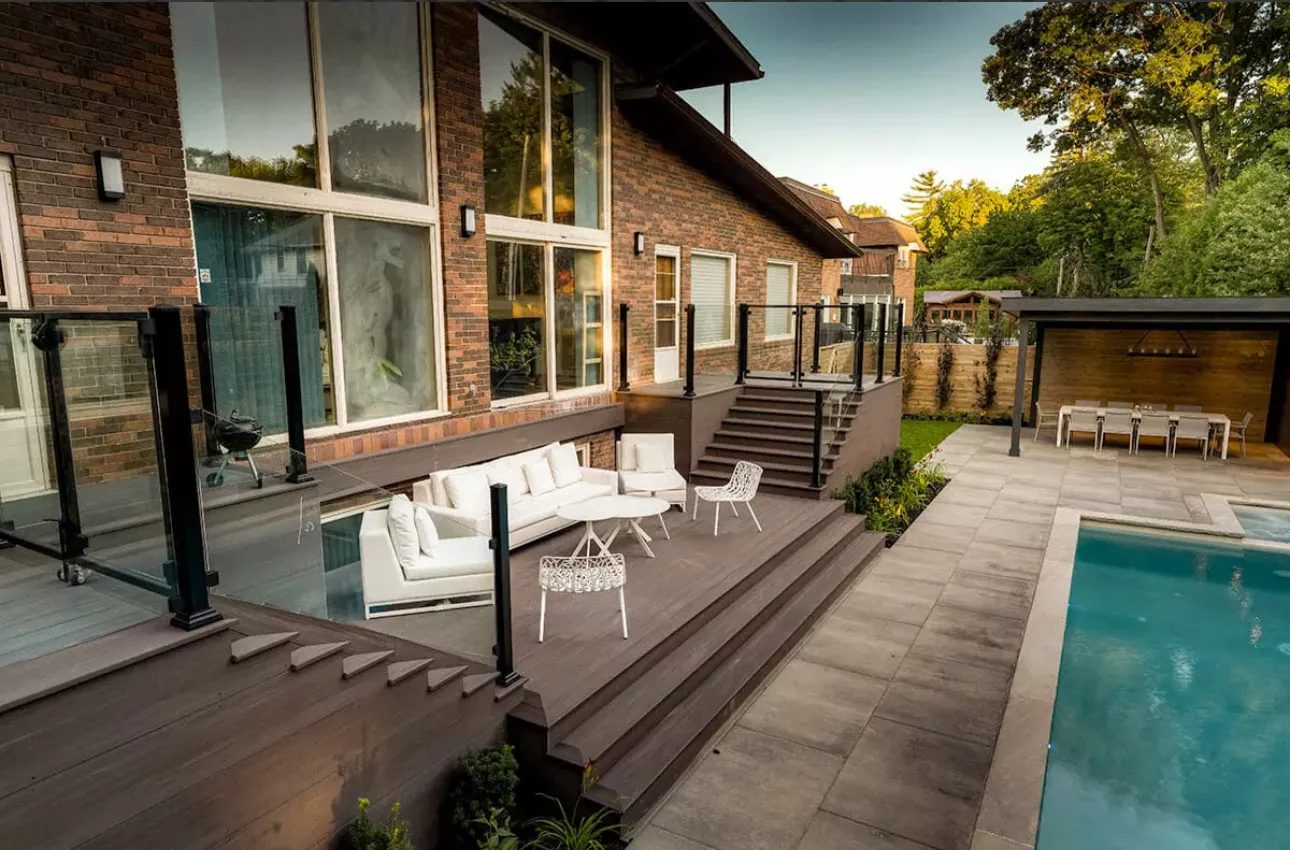
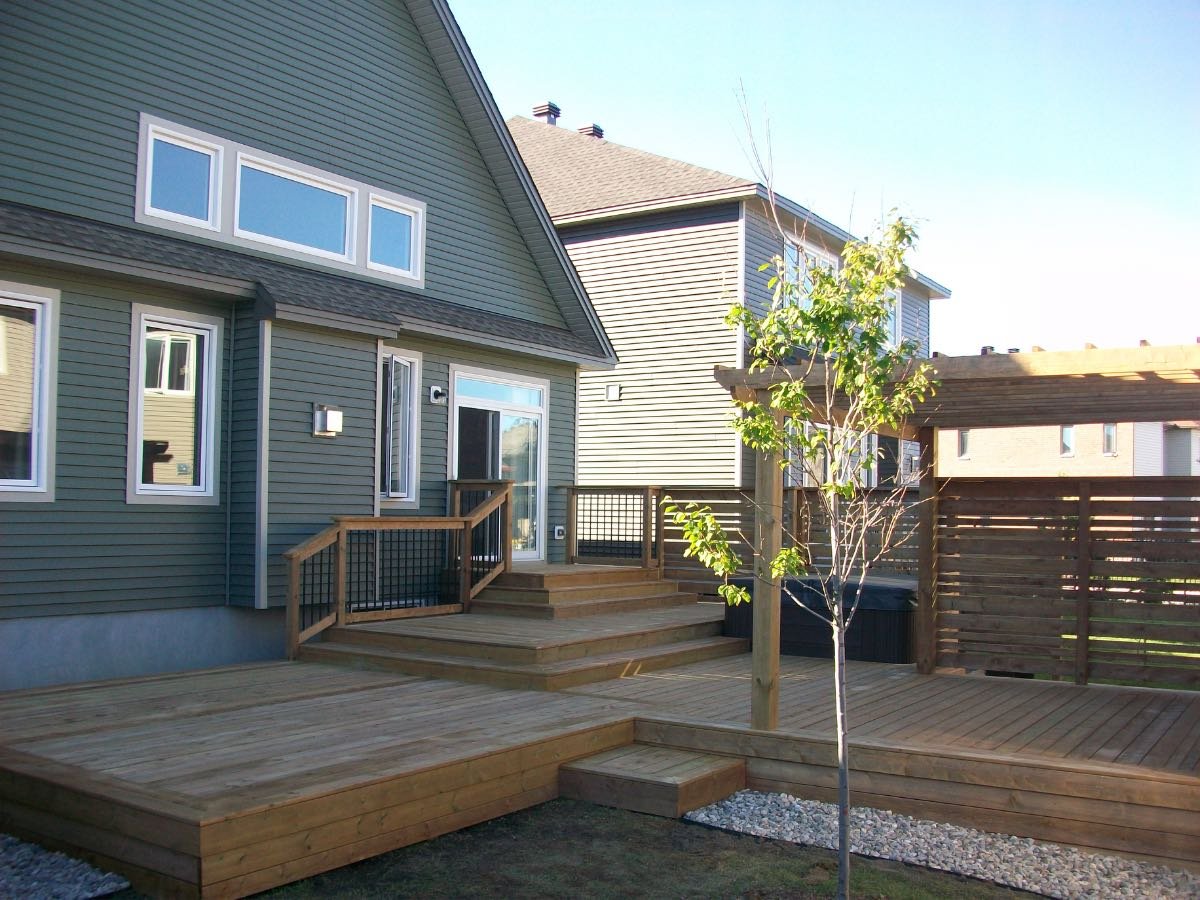
Our project gallery is filed by the type of work rather than by the board that was used, so we cannot point at a photo on this page and confirm it is an Azek or Clubhouse build. Rather than attach a material we cannot verify, we are simply not doing that. What you can see is our full gallery of the work we build, and as we start tagging projects by material we will add verified PVC photos here instead.