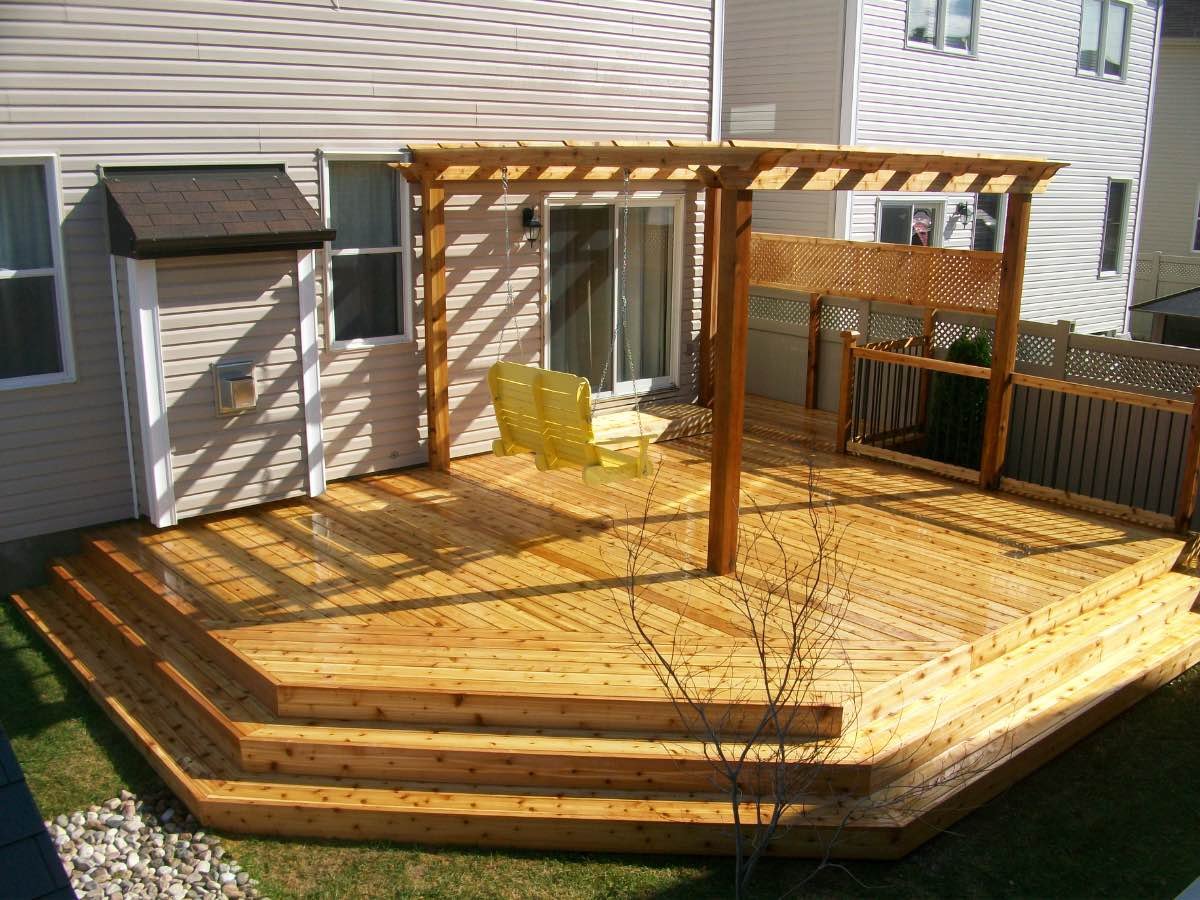

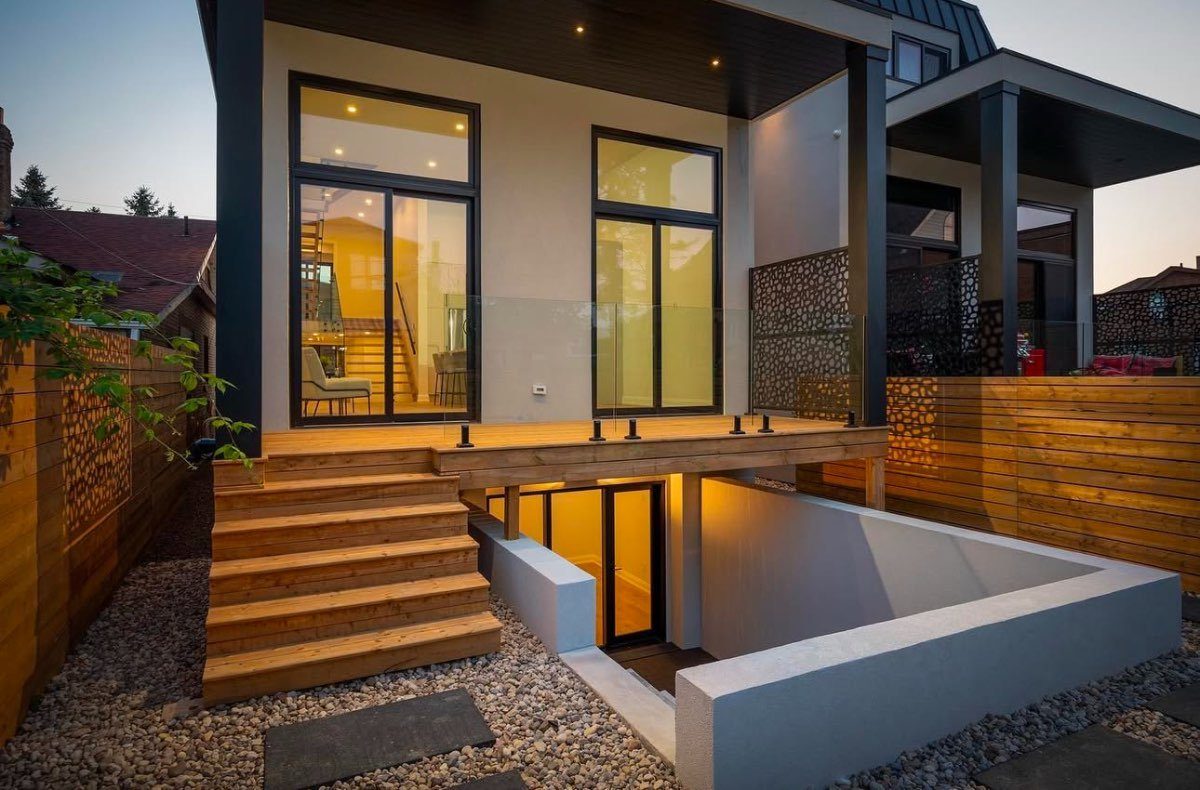
Cedar is the natural-wood option in our four-material range, and it is the one with the most decisions attached to it: which grade, seasoned or unseasoned, which fasteners, and what happens where the structure meets the ground. This page covers all four, because those are the decisions that separate a cedar deck holding its colour from one that is grey and streaked in three seasons. If you have not settled on a material yet, start with every deck material we build in Ottawa, with costs and permit rules. We are licensed, insured and family-owned, building in Ottawa since 2016, and every build carries a written workmanship warranty.
Call (613) 902-6137 or book a free consultation. The four steps every project follows, from that consultation to the build, are on our page for decks in Ottawa.
Why cedar behaves differently here than any other board we install
Every material we build in has to survive the same Ottawa year: repeated freeze and thaw, meltwater, and salt tracked in off the driveway and the walkway. Composite and PVC survive it by being largely inert. Cedar survives it chemically.
Western red cedar heartwood carries natural extractive oils, and those oils are the reason the species resists rot and insects without being pressure-treated. They are also the reason cedar is fussier about what you screw it down with. The Western Red Cedar Lumber Association is direct about it: electroplated fasteners “can rust and disintegrate and react adversely with the natural preservative oils present in cedar, resulting in stains and streaks,” and copper nails “also react with cedar and should not be used.”
That is not a cosmetic footnote. It is the single most common way a cedar deck in this city starts looking old early. The board is fine. The fastener bled into it.
Cedar is also light. The WRCLA lists western red cedar at an oven-dry density of 21 pounds per cubic foot, the lowest of the softwoods in its comparison table. Low density is why cedar stays cooler and smoother underfoot than most boards on a hot July afternoon, which is the thing homeowners actually notice. It is also why cedar dents more easily than a composite board under a dragged patio chair. Both facts come from the same property, and you get them together.
The fastener spec, which almost nobody asks about and everybody sees
Because the extractive oils drive this, the fastener is a material decision rather than a hardware-aisle decision. Working from the WRCLA fastener recommendations:
- Nails.Hot-dipped galvanized, aluminum and stainless steel are all corrosion resistant and all acceptable on cedar. Electroplated is not. “Stainless steel is the best choice but hot-dipped galvanized is the most widely used and economical.”
- Screws. Double hot-dipped galvanized will do, but the association recommends stainless. Grade 304 gives adequate corrosion resistance for most applications; grade 316 is specified for decks exposed to salt air.
- Penetration. Screws have to reach 25 mm into the support member, and 38 mm where the component is structural.
- Spacing. Deck boards 51 mm wide take one nail per joist. Boards 102 mm and wider take two.
- Hidden fastening. Clip and bracket systems fix the board from the side or underneath, so the finished surface carries no visible fastener at all. On cedar that also removes every future opportunity for a fastener to stain the face.
One honest note on salt, because it is the Ottawa question. The 316 recommendation above is written for salt air, meaning coastal exposure. Ottawa is not coastal, and the WRCLA does not write to road salt either way. A cedar deck sitting within splash range of a salted walkway or driveway is still seeing chloride, so which grade of stainless goes into that build is a decision worth settling on the drawing rather than at the hardware counter. Ask any quote you receive, ours included, which grade it is priced on.
On an Ottawa cedar deck, the part nearest the ground is not cedar
This is the fact that surprises people, and it is the reason “a cedar deck” is a slightly loose phrase everywhere it is used, including on this site.
Cedar’s natural durability is a property of its heartwood. It is not a code exemption for ground contact. Wood Preservation Canada, summarising the National Building Code requirements for housing and small buildings at Articles 9.23.2.2 and 9.23.2.3, sets out the rules that apply to decks and other exterior platforms:
- Preservative treatment is required for wood in ground contact.
- Preservative treatment is required for wood members at or below ground level framed into masonry or concrete, unless a 12 mm air space is provided at the end and sides of the member.
- Preservative treatment is required for wood members within 150 mm of the ground, unless the member sits on concrete and is separated from it by polyethylene film, roll roofing or equivalent dampproofing.
So a cedar deck in Ottawa is a cedar surface and, usually, a cedar railing and skirt, on a frame that is pressure-treated where the code says it has to be. Anyone who tells you the whole structure is cedar is either describing something the code does not permit at grade or is not being precise about which members they mean.
Two things follow that are worth knowing before you compare quotes. The first is that this is normal and correct, not a corner being cut. The second is that the transition between treated frame and cedar surface is exactly the joint where the wrong fastener does its damage, which is why the two sections above belong together.
Worth flagging for completeness: the same Wood Preservation Canada page notes that Ontario has not adopted the treating requirement for wood not protected from exposure to precipitation, and that very few Ontario locations carry a moisture index above 1.00. Ottawa is a freeze-thaw problem, not a coastal-damp problem, and the code treats it that way.
Which cedar grade you are actually buying
“Cedar” on a quote is not one product. The WRCLA publishes four decking grades, and the differences are visible and priced:
| WRCLA decking grade | Appearance | Supplied |
|---|---|---|
| Architect Clear | Fine grained, the top of the range, usually made to individual order | Seasoned or unseasoned |
| Custom Clear | Clear appearance with limited characteristics, finely machined | Seasoned or unseasoned |
| Architect Knotty | Sound, tight knots, smooth skip-free dressing over the whole face | Seasoned or unseasoned |
| Custom Knotty | Hole-free knotty appearance, the economical knotty deck | Unseasoned only |
That last cell is the one that matters for scheduling. Unseasoned cedar is green, which means it still has moisture to give up, and it will move as it dries. If you want a knotty deck at the economical end of the range, you are buying a board that will change slightly in its first season, and the fastening and gapping have to be planned for that. Ask any builder quoting you a cedar deck which grade they have priced. If the answer is just “cedar,” the quote is not comparable to another one.
Finish it before it is a deck
This is the single most useful thing on this page, and it is the reason cedar rewards a builder who plans rather than one who just installs.
The WRCLA’s own finishing guidance says to “apply the stain to all 6 sides of each board prior to construction,” and to apply it liberally to end grain, nail holes and cracks. All six sides. Before construction. Once a board is fastened down, four of its six faces are unreachable forever, and the end grain, which is where a board drinks water fastest, is the hardest of all to get at.
The practical consequences:
- The finish decision has to be made before the boards go down, not the following spring when you get around to it. That moves it earlier in the project than most homeowners expect.
- It needs a clean, dry board and dry weather for the coating stage, which in Ottawa is a real constraint on when this part of the build can happen.
- The WRCLA also says never to power-wash a cedar deck, because it damages the wood fibres. Anyone who arrives with a pressure washer to prep or clean cedar is working against the material.
For upkeep afterwards, the association’s advice is plain: clean the deck once a year, in spring, to clear dirt, mildew and discolouration, and remember that “a deck that dries after wetting will last longer than one that stays damp.” Then re-oil every couple of seasons to hold the tone, or let it weather to silver on purpose. Both are legitimate. Silvered cedar is a look a lot of Ottawa homeowners choose deliberately, and choosing it is not the same as neglecting the deck.
Cedar against the other three materials we build in
We build in four materials and we will tell you when cedar is the wrong one. Here is the honest comparison on the things that differ:
| What differs | Western red cedar | Pressure-treated | Composite | PVC |
|---|---|---|---|---|
| Installed cost per sq ft, published 2026 Canadian ranges | $60 to $90 | $35 to $60 | $100 to $130 | $100 to $130 |
| Routine upkeep | Clean yearly, re-oil every couple of seasons | Clean and re-stain every couple of years | Wash a couple of times a year | Wash a couple of times a year |
| If you do nothing | Weathers to an even silver-grey | Greys, and boards can cup, check and crack | Little visible change | Little visible change |
| Warranty on the boards themselves | None. It is a natural product | None | Manufacturer warranty (Trex, Fiberon, TimberTech) | Manufacturer warranty (Azek, Clubhouse) |
| Underfoot in full sun | Coolest and smoothest of the four | Real wood, roughens with age | Warmer than wood in dark colours | Lightest and most moisture-proof |
| Dent resistance | Softest of the four, marks more easily | Harder than cedar | Hard shell | Hard |
| Where it wins | A quiet sitting deck where you want real wood, warm colour and clean grain | The largest deck for the smallest budget | A busy family deck, kids, pets, bare feet | Poolside and full afternoon sun |
Prices are the published 2026 Canadian ranges this site already cites, not an Ottawa Decking Solutions quote.
Read the warranty row twice, because it is the trade-off nobody puts in writing. Composite and PVC boards carry manufacturer warranties against fade and staining. Cedar does not, and no honest builder can offer one, because it is a tree. What a cedar deck carries is our written workmanship warranty on the build, with the terms set out in your signed project agreement. Those are two different promises and they are frequently blurred in this trade. If the material warranty is what matters most to you, cedar is the wrong choice and we will say so and quote you composite instead.
Each of the other three has its own page. Cedar’s nearest neighbours are pressure-treated decks, the same wood build for less and composite decks, if you would rather never re-oil anything; the fourth is PVC decks for poolside and full afternoon sun. All four sit together on our deck materials page, which carries the cost table and the permit rules for every material.
For the full four-way argument, including how each family behaves over a longer horizon, read our guide on choosing between composite, cedar and pressure-treated decking.
Does a cedar deck need a City of Ottawa permit?
The material makes no difference to this. The City’s tests are about height, area and how the deck attaches, and a cedar deck is assessed exactly as a composite one is. Three conditions trigger a permit:
- If the deck is adjacent to or attached to the house and its walking surface is more than 600 mm (24 in.) above the adjacent grade, a permit is required, whatever its area.
- If the deck is an elevated deck providing principal access to a building, a permit is required.
- If the deck is independent from the house and has a walking surface greater than 10 square metres (about 108 square feet) and its walking surface is more than 600 mm above the adjacent grade, a permit is required.
The conjunction in that third test is the City’s own, and it is reported wrong often enough to be worth stating: a freestanding deck has to fail both the area test and the height test before it needs a permit. Source: City of Ottawa, Decks: do I need a building permit?
Where a permit is needed, the City inspects the work in three stages: excavation and foundations, for in-situ piers and pads prior to backfill; framing, at completion of structural framing and guards; and final. Inspections should be booked 48 hours ahead, and the permit plans have to be on site when the inspector arrives. Because every project we build is modelled in 3D and AutoCAD before a board is cut, those same drawings are what the application needs. We prepare them, file the application and carry the setbacks.
One practical detail we have checked and most pages have not: the City’s web page asks for “a complete set of detailed plans,” while the City’s own sundeck checklist and sample plan PDF asks for two complete sets. Bring two and you satisfy both documents.
More on the process, including what a Development Information Officer can and cannot advise on: do you need a permit for a deck or fence in Ottawa.
When can a cedar deck actually get built in Ottawa?
The ground decides the start date, not the calendar. Footings have to sit below the frost line on stable, workable ground, and deep-winter frozen ground and peak spring thaw are both genuinely unworkable. That constraint is the same for every material and every contractor in this city.
What is specific to cedar is the finishing stage. Because the WRCLA guidance is to coat all six faces of every board before construction, a cedar build has a dry-weather coating step that a composite build simply does not have. That step wants clean, dry boards and it wants to happen before the deck goes together, so it has to be scheduled rather than squeezed in.
The half of the project that is not weather-dependent is the half people leave too late: the 3D design, the material and grade decision, and the permit application. None of that needs unfrozen ground. Starting those while the ground is still hard is the one part of this timeline you fully control. We cover the whole calendar in the best time to build a deck in Ottawa.
Is cedar good for building a deck?
Yes, with a condition attached. Cedar is a genuinely good decking material: naturally resistant to rot and insects without chemical treatment, warm in colour, clean in grain, cool and smooth underfoot, and, in the WRCLA’s words, “properly finished and maintained, cedar will deliver decades of trouble-free service.”
The condition is the phrase “properly finished and maintained.” Cedar is the material that rewards attention and shows neglect. If a yearly clean and a re-oil every couple of seasons is something you will genuinely do, or if you actively want the silvered look, cedar is an excellent choice. If you want to install a deck and never think about it again, you want composite or PVC and we would rather sell you that than sell you a cedar deck you will resent.
What does a cedar deck cost in Ottawa?
We do not publish a fixed price list, because size, structure, railings, stairs, lighting, site access and whether the City needs a permit all move the number, and quoting a square-foot rate before seeing the yard is how people end up with a number that changes later.
What we can give you is the published range this site already cites. Installed cedar decking runs roughly $60 to $90 per square foot on 2026 Canadian industry ranges, against $35 to $60 for pressure-treated and $100 to $130 for composite or PVC.
Applied to the two sizes people search for most, purely as arithmetic on a national range:
| Deck size | Walking surface | Cedar at the published national range |
|---|---|---|
| 12 ft by 12 ft | 144 sq ft | about $8,600 to $13,000 |
| 20 ft by 20 ft | 400 sq ft | about $24,000 to $36,000 |
Those are not quotes. They are a national range multiplied by an area, they carry none of your site conditions, and a 20 by 20 deck more than 600 mm off the grade is a permitted build with drawings and inspections attached. We design in 3D first and then give you one project-specific price.
Financing is available through our third-party partner iFinance if it helps spread a larger project. Anything discussed in conversation is illustrative and is not an offer of credit.
What is the 3/4/5 rule for decks?
It is how you square a corner without a large square. Measure 3 units along one side from the corner, 4 units along the other, and if the diagonal between those two marks is exactly 5, the corner is at 90 degrees. Any consistent unit works, and larger multiples such as 6, 8 and 10 are more accurate over a big frame.
It matters more on a cedar deck than on most, because a knotty cedar surface with visible grain shows a frame that is out of square in every board line. On a plain composite board you might not see it. On cedar you will.
What actually makes a deck fail?
You will find the claim that ninety per cent of deck collapses are caused by ledger failure repeated across a lot of contractor blogs. We have not been able to trace that figure to a primary study, so we are not going to state it as fact on our own site. If you see it quoted at you with confidence, ask where it comes from.
What is not in dispute is the mechanism. The connection between the deck and the house, and the footings under it, are the two things that fail structurally, and they are the two things the City of Ottawa inspects: the foundation inspection happens before backfill, and the framing inspection happens at completion of structural framing and guards. Both of those exist because those are the stages you cannot see once the work is finished.
The related question people ask, whether to frame in 2x6 or 2x8, has no single answer. It is set by the span, the joist spacing and the load the deck has to carry, and it is resolved against the span tables and confirmed at the framing inspection, not by a rule of thumb. We size it in the 3D model before anything is ordered.
Common cedar deck mistakes we are asked to fix
- The wrong fastener.Electroplated screws, or copper, reacting with cedar’s own oils and streaking the boards. Cosmetic at first, and it does not reverse.
- Finishing after construction. Four faces and the end grain are already sealed off by then.
- Power-washing. It damages the wood fibres and raises the grain, and it is the standard advice everywhere except from the people who grade the lumber.
- Unseasoned boards fastened as though they were dry. Green cedar moves. Custom Knotty is supplied unseasoned only, so this one is common at the value end of the range.
- Grade not specified on the quote. Four grades, four prices, one word on the estimate.
- Trapped moisture. Debris in the gaps and poor drainage keep a deck damp, and a deck that stays damp does not last as long as one that dries.