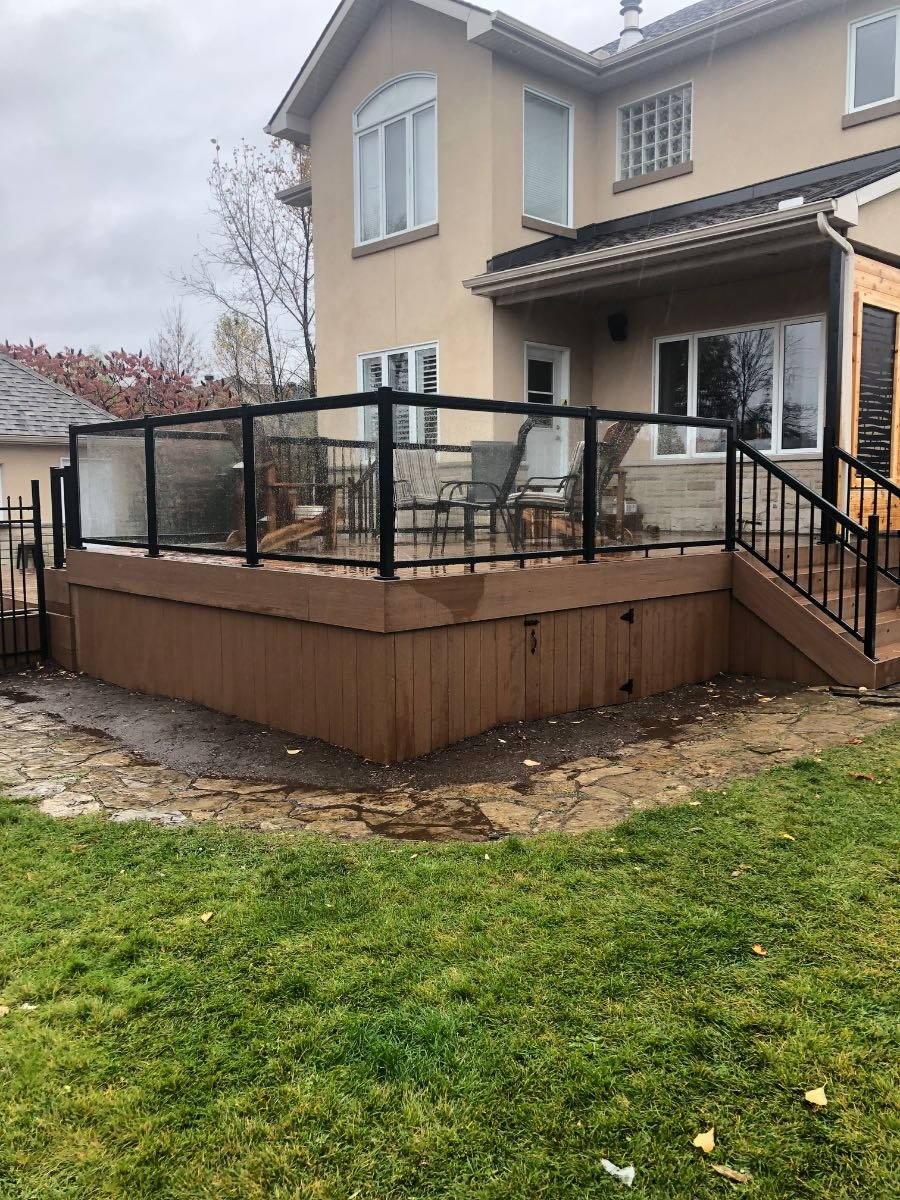

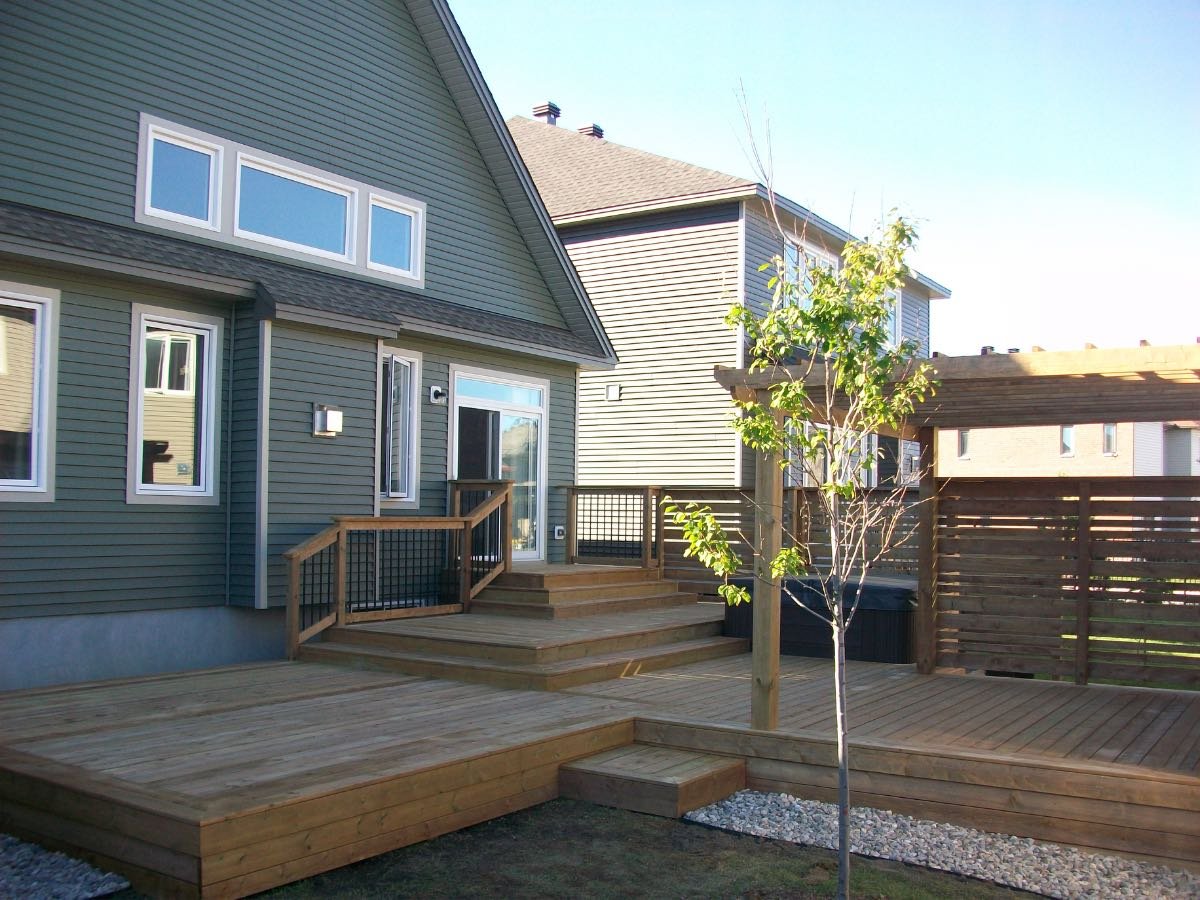
The wood arrives wet from that process. It moves as it dries, and it wants cleaning and re-staining every couple of years to hold its colour through our wet, dry and freezing swings. Everything that decides whether it is still level in year ten happens below the boards.
Do you use pressure-treated wood for decks?
Yes, you can build a whole deck in pressure-treated wood, posts and boards included, and even a composite or PVC deck still sits on a wooden frame. Under CSA O80.1 the grade depends on where the wood sits: a post set in the ground to hold the deck up is use category UC4.2, for critical structural parts in ground contact, and wood kept out of ground contact is UC3. We go through where each grade belongs further down.
What “pressure-treated” actually means in Canada now
Most people picture the green wood from a 1990s backyard. That product is not on the shelf any more. Chromated copper arsenate, CCA, was voluntarily withdrawn from residential markets, and Environment and Climate Change Canada records the cutover plainly: as of 31 December 2003 it can be used only for industrial wood products. Health Canada’s consumer sheet says the same thing, that CCA is no longer available for residential construction projects.
What replaced it is copper-based and browner. The formulations sold for decks today are organometallic preservatives, and in Canada only preservatives registered by the Pest Management Regulatory Agency may be used at all.
The standard behind all of it is CSA O80. The Canadian Wood Council states that the CSA O80 series is referenced in the National Building Code of Canada and in provincial building codes, and that Canadian preservation standards are the American Wood Protection Association standards modified for Canadian conditions. So “pressure-treated” is not a marketing word. It is a specification, with a retention and a penetration the treater has to hit.
That matters to you for one practical reason. Two boards on the same rack can be treated to different levels, and putting the wrong one in the wrong place is the most common way a pressure-treated deck fails early.
Two grades of the same board, and where each one belongs
CSA O80.1 sorts treated wood into use categories. The two that decide a deck:
- UC3 covers exterior construction not in ground contact. It splits again: UC3.1 for coated wood with rapid water run-off, UC3.2 for uncoated wood or poor run-off.
- UC4 covers exterior construction in ground or freshwater contact. UC4.1 is non-critical components. UC4.2 is critical structural components, or components that are difficult to replace.
Read UC3.2 again, because it is the category most Ottawa deck boards actually live in. An uncoated deck surface with meltwater sitting on it after a March thaw is not the same exposure as a coated, fast-draining board, and the standard treats them differently.
The failure case is a post. A board rated for above-ground service, buried in the ground as a support post, is a deck with a clock on it, and nothing you do to the surface stops that clock. A post in the ground is a UC4 job, and if it is holding the deck up it is the difficult-to-replace kind. This is invisible once the deck is built, which is exactly why it is worth asking any contractor about before you sign, ours included.
The fasteners are part of the material, not a detail
Copper-based preservatives and plain steel do not get along. The manufacturers publish the spec, so this is checkable rather than a matter of opinion. Koppers, whose MicroPro Sienna brand is the treated wood most Canadian retailers stock, sets out minimum galvanization for anything in direct contact with treated wood in an exterior application:
- Fasteners, meaning nails and screws: ASTM A153, one ounce per square foot.
- Hardware, meaning connectors and joist hangers: ASTM A653 G90, 0.90 ounces per square foot.
- Stainless steel, types 304 and 316, for severe exterior applications. The brand names swimming pools and salt water exposure as its examples.
Source: MicroPro Sienna, fastener and hardware information.
There is an Ottawa judgement call sitting inside that last line, and we would rather name it than pretend it is settled. The spec says salt water, meaning marine exposure. It does not say road salt. But a deck landing at the foot of a driveway that gets salted every winter sits closer to that end of the range than a deck at the back of a fenced yard does, and where a build has that exposure we would rather discuss stainless at design time than explain rust at year five.
One more thing the spec implies. Every cut made on site opens up wood the treatment never reached, because the preservative is driven in from the outside. Koppers registers a product called Cut-N-Seal for exactly that job, which tells you how seriously the treater takes a sawn end. Stair stringers and notched posts are where this shows up most.
How pressure-treated wood behaves through an Ottawa winter
The wood is saturated with water during pressure treatment. That is the manufacturer’s own description of its state when it leaves the plant, and it explains most of what a new pressure-treated deck does in its first year.
It dries. As it dries it shrinks, and because a board dries faster on its exposed face than through its core, it cups, checks and splits at the ends. None of that is a defect. It is wet softwood doing what wet softwood does.
Then Ottawa gets involved. Water finds the checks, freezes, and widens them. A surface left unfinished greys, which some people want. The parts that decide whether the deck is still true are underneath: footings that reach below the frost line or to solid rock, hardware that has not been eaten by corrosion, and a frame flashed properly where it meets the house.
That is the honest hierarchy for this material. Boards are the cheapest part of a deck to change. Footings are the part you cannot change without taking the deck apart, and they are the reason we look at framing and footings before quoting anything.
Pressure-treated against cedar, composite and PVC
We build in all four and we do not have a house favourite. Our deck materials hub sets all four against each other on price and on the permit thresholds. Here is the comparison on properties rather than on prices, because we do not publish a price list and an invented number would be worse than none.
| Pressure-treated | Cedar | Composite | PVC | |
|---|---|---|---|---|
| Relative up-front cost | Lowest of the four | Above pressure-treated | Above cedar | Highest of the four |
| What upkeep actually is | Clean and re-stain every couple of years | Clean and re-oil every couple of seasons, or let it go silver | Wash a couple of times a year | Wash a couple of times a year |
| Colour if left alone | Brown fades to tan, then to grey | Weathers to silver | Holds colour through freeze-thaw | Most fade-resistant of the four |
| Manufacturer product warranty | Brand-dependent. MicroPro Sienna publishes a Lifetime Residential Limited Warranty for first owners against structural failure caused by fungal decay or termites | None. Cedar is a species, not a branded product | Trex, Fiberon and TimberTech carry their own fade and stain warranties | Azek and Clubhouse carry their own |
| What usually ends it | Fastener corrosion and frame rot, rarely the boards themselves | Surface decay if it is never refinished | Mechanical damage, and the wood frame underneath it | Mechanical damage, and the wood frame underneath it |
| Where it wins | The largest deck for the budget, and the easiest to extend or repair board by board | Warm and cool underfoot, and it cuts cleanly for awkward angles on a tight lot | Low upkeep with a wood-like surface | Poolside, full afternoon sun, and the wettest corners of a yard |
Two things that table is quietly telling you.
The bottom two rows matter more than the top one. A synthetic deck still sits on a wooden frame, so the fastener and footing questions above do not disappear when you choose composite. They just stop being visible.
Cheap boards do not make a cheap deck.Because pressure-treated lumber is the least expensive surface of the four, a larger share of a pressure-treated deck’s price is labour, excavation, footings, stairs and railings. Those do not get cheaper when the board does. It is why the gap between a pressure-treated quote and a composite quote is always narrower than the gap between the board prices at the lumberyard.
Full material comparison: composite vs cedar vs pressure-treated.
Does a pressure-treated deck need a City of Ottawa permit?
The material makes no difference. The City’s tests are about height, area, attachment and access, and they read the same whether the deck is pressure-treated, cedar, composite or PVC. The City of Ottawa publishes three conditions, and these are its words:
Regardless of the deck’s walking surface area, if the deck is adjacent to or attached to the house and its walking surface is more than 600 mm (24 in.) above the adjacent grade, a permit is required.
Regardless of the deck’s walking surface area, if the deck is an elevated deck providing principal access to a building a permit is required.
If the deck is independent from the house (eg. is in the middle of the yard) and has a walking surface greater than 10 square metres (approximately 108 square feet) in area and its walking surface is more than 600 mm (24 in.) above the adjacent grade, a permit is required.
The andin that third one is the City’s own. A freestanding deck has to fail both tests, area and height, before it needs a permit. A deck attached to the house is not exempt by size at all.
Source: City of Ottawa, Decks: do I need a building permit? The City also publishes a sample sundeck plan and checklist (PDF), which shows the drawing standard it expects. The City sets these thresholds and can change them, so we confirm the current requirement for your specific build rather than working from what a neighbour put up.
If your project needs one, the permit drawings come out of the same 3D and AutoCAD model we build for you to approve, so the design work is not done twice.
What happens if you build a deck without a permit in Ontario?
The requirement is provincial law, not a City preference. Section 8 (1) of Ontario’s Building Code Act, 1992 reads:
No person shall construct or demolish a building or cause a building to be constructed or demolished unless a permit has been issued therefor by the chief building official.
We are not going to quote you a fine. The Act creates an offence and a court decides the rest, and any number on a contractor’s website for this is somebody’s guess.
The cost most people actually meet is the inspection one. A permitted sundeck in Ottawa carries three required inspections: excavation and foundations on in-situ piers and pads before backfill, framing at completion of the structural framing and guards, and a final. They are meant to be booked 48 hours ahead with the permit plans on site. The City warns in its own words that failing to have the appropriate inspection performed may result in having to uncover and expose the work. On a deck, that means the footings, which means the deck.
Sources: City of Ottawa deck permits and Building Code Act, 1992, S.O. 1992, c. 23. Full walkthrough: Ottawa deck and fence permits.
How much should a pressure-treated deck cost per square foot in Ontario?
We do not publish a price list, and here is the reasoning rather than a dodge. Size, ground conditions, drainage, stair count, railing style and whether the City needs a permit move the figure enough that a published number would mislead more people than it helped.
What we can tell you is what drives it on this material specifically:
- Footings and excavation. Identical work whichever board goes on top, and a bigger share of a pressure-treated budget because the boards cost less.
- Stairs and railings. The most labour-dense parts of any deck, and they scale with height rather than with area.
- Height above grade. Cross the 600 mm line and you have added a permit, drawings and three inspections to the schedule.
- Hardware grade. The galvanization spec above is not where to economise.
For orientation only, published 2026 Canadian industry ranges put installed pressure-treated decking at roughly $35 to $60 per square foot, against roughly $60 to $90 for cedar and $100 to $130 for composite or PVC. Those are national industry ranges, not an Ottawa Decking Solutions quote, and we cite them the same way our deck cost guide does.
On the 20 by 20 deck people ask about: that is 400 square feet, about 37 square metres. Well past the City’s 10 square metre threshold, so if it is freestanding and more than 600 mm above grade it needs a permit, and if it touches the house the area never mattered.
When can you build it, and when can you stain it?
Two different windows, and people miss the second one.
The build window is set by the ground. Footings have to reach below the frost line or to solid rock, and that needs workable ground. Deep-winter ground is frozen too hard to dig properly. Spring thaw turns the top layer to mud before it firms up. Then every deck and interlock crew in Ottawa is booking the same few months, which is a trade-wide pattern rather than a claim about our calendar. Late summer and autumn builds get stable ground and calmer scheduling.
What does not wait for weather: the 3D design, the material choice, the permit drawings and the application. All of that can happen in January.
The staining window is set by the wood.The boards arrive saturated from the treatment plant, and finish applied to wet wood does not take. Koppers’ guidance is that unless the finish manufacturer says otherwise you can apply a semi-transparent stain or water repellent as soon as the wood is dry to the touch after construction, and it publishes a test anyone can run: sprinkle water droplets on the surface. If they soak in, the wood is ready for stain. If they bead, try again in a few days.
That test is the answer to the most common pressure-treated regret we hear about, which is a deck sealed too early that had to be stripped and done again.
Source: MicroPro Sienna, finishing and maintenance.
The calendar closes that window from the other end. Stain keeps curing for eight to twelve hours after it goes on, so in Ottawa the overnight low ends the staining season, at the end of September in a normal year. Our guide on when to stain a deck in Ottawa has the monthly numbers.
More on timing: when is the best time to build a deck in Ottawa?
When pressure-treated is the wrong answer
Worth saying plainly, because a page selling one material rarely does.
Pick something else if the deck wraps a pool, if it takes full afternoon sun on a south face, or if you already know you will not spend a weekend on it every second spring. Those are the cases where the upkeep either never happens or is fighting conditions it will lose to, and where PVC decking earns its price. If you want real wood, warm underfoot, and you like the idea of it going silver on its own, cedar decking is the better version of that instinct. If you want the wood look with almost no upkeep, composite decking is the middle.
Pick pressure-treated if you want the most deck for the money, if you may extend or reconfigure it in a few years, or if you would rather put the budget into size, stairs and a pergola than into the surface. It repairs board by board, which none of the synthetics really do.
We also do deck repair, staining and stripping on existing decks. If the pressure-treated deck you already own has grey, split boards on a sound frame, replacing all of it is not automatically the answer.
Whichever board you settle on, the footings and the permit work are the same job, and our page for deck builders in Ottawa sets out how we run a build from the first call.
About the photos on this page
Our project gallery is organised by the type of work rather than by material or neighbourhood, so we are not going to point at a photo here and tell you it is a pressure-treated build in a particular part of Ottawa when we cannot confirm it. You can see the full gallery of the work we build instead. As projects get tagged by material we will put verified pressure-treated photos on this page rather than a general link.