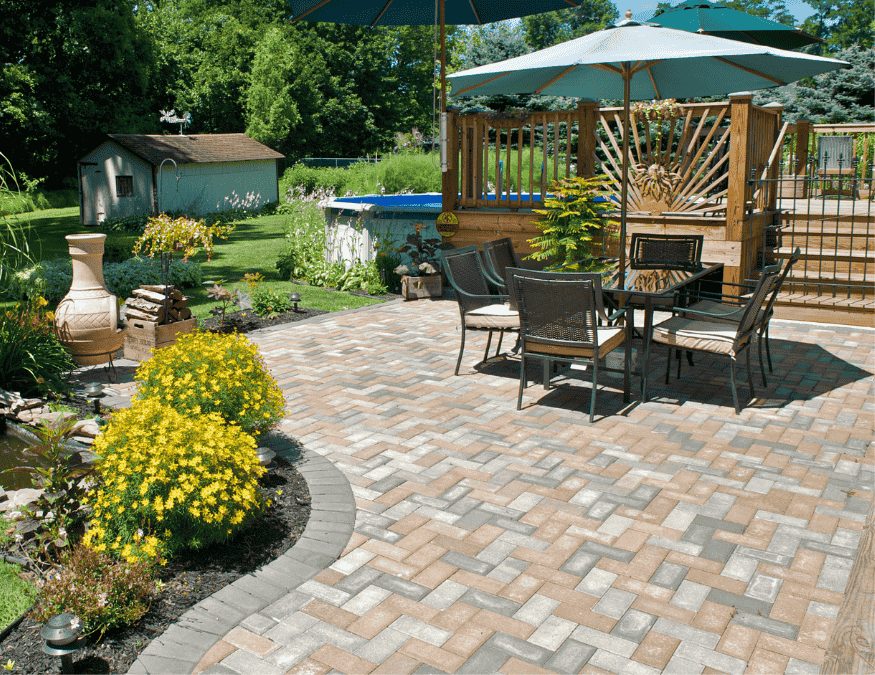

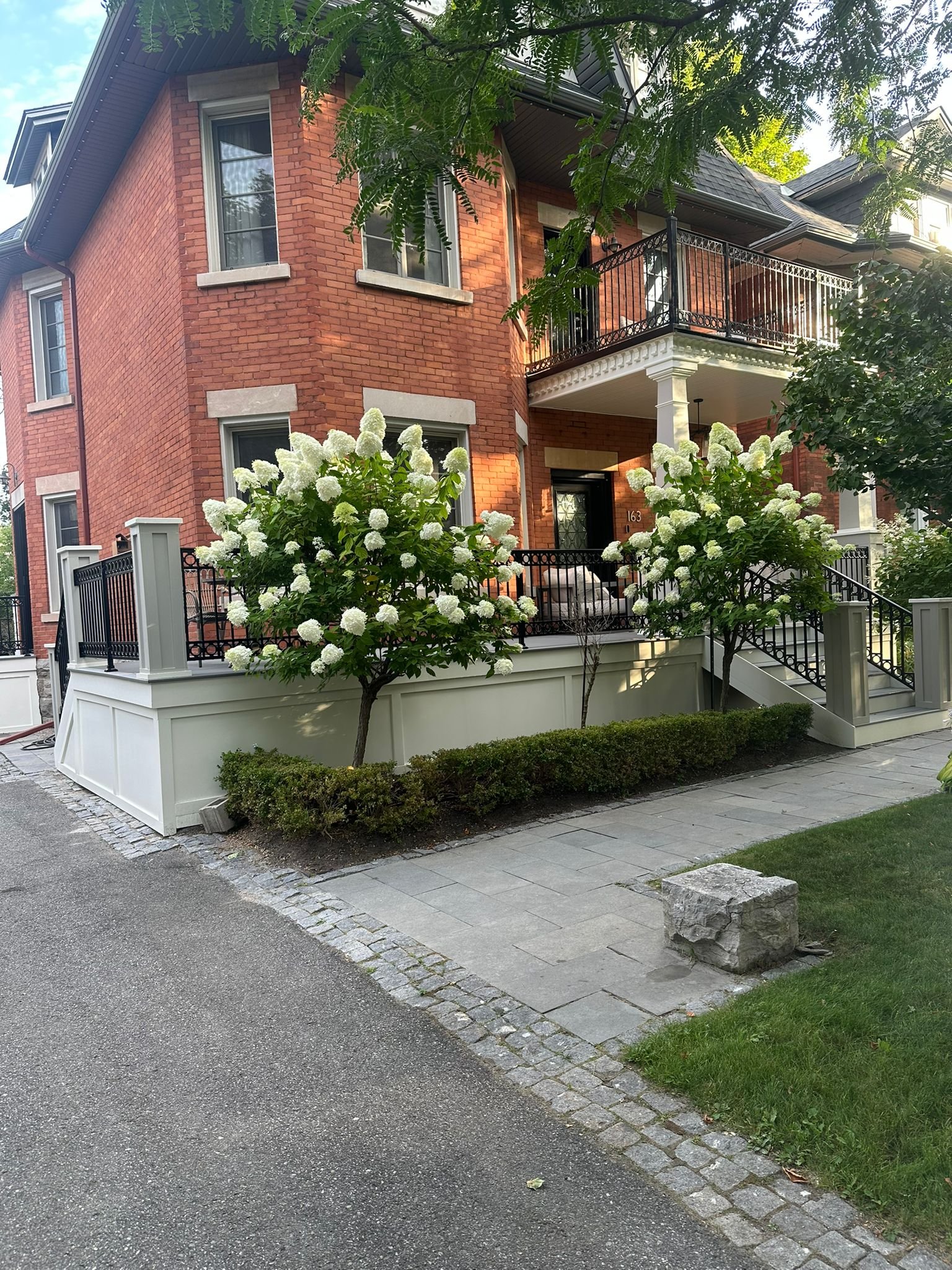
We lift the pavers that have dropped, find out why the base under them moved, correct and re-compact it, and relay the same stone so the repair does not show as a patch. What decides the price, and whether a repair will hold, is the cause underneath: very often a downspout, a grade that tips back toward the house, or a driveway apron built on a patio-depth base. Ottawa Decking Solutions is an insured, family-owned Ottawa contractor repairing interlock driveways, patios, walkways and steps in Ottawa and Gatineau, and we look at the base before we quote.
What we repair
Sunken and dipping sections are what most people call about: a low spot where water sits after rain, a paver that rocks underfoot, or a top step that has dropped away from the door.
Driveway aprons come next. The strip where the car turns in and brakes carries the most load on the property, so when a driveway was built on less base than a vehicle needs, the apron shows it first, usually as ruts in the wheel paths.
Heaved sections push up instead of down. Frost working on a wet base does it, and so does a tree root lifting the field from underneath; the fix differs for each.
Joints wash out. The sand between pavers holds them together as one surface, and once it has gone, single stones start moving and ants and weeds move into the gaps.
Edges spread. The outside row of a patio or walkway has stone on one side only, so when the edge restraint fails the field widens and the joints open.
Front walkways and stone steps take salt, shovels and the heaviest foot traffic on the property. A step that shifts is worth dealing with early, because an uneven riser trips someone long before it looks bad.
A retaining wall that leans or bulges gets treated differently. That is a drainage failure behind the wall and we look at it as a structural question. Our retaining walls and steps page covers what goes wrong behind the face.
Repair, relay or rebuild: matching what you see to the job
| What you see | What is usually happening underneath | The job it usually turns into |
|---|---|---|
| One dip, one rocking paver, one dropped step | A local soft spot in the base, often where water collects | Repair. Lift that area, correct the base, relay the same stone |
| Dips in several places, stone still in good shape | Base compacted poorly across a wider area, or water spread across the surface | Relay. Lift the whole area, rebuild the base across it, reset the stone |
| Driveway apron rutted in the wheel paths | Base built to a pedestrian depth under a vehicle load | Relay or rebuild, depending on how much base is actually there |
| The same spot sinking again a season or two after a reset | The cause was never corrected: usually water | Fix the water first, then relay |
| Joints empty but the surface is level | Joint sand washed or swept out; base still sound | Re-sand the field with polymeric sand |
| Pavers crumbling, flaking or broken, not just displaced | The stone itself has failed, often from salt and freeze-thaw | Replace those units, or rebuild if the damage is widespread |
| Stone pushed up near a tree | Root growth under the base | Relay around a decision about the root, which has to be settled first |
We would rather tell you it is a rebuild before you pay for a repair than relay the top of a failing base twice. The long version of that distinction is in our guide to how an interlock repair works.
Why the same spot keeps sinking: follow the water
Most repeat repairs trace back to water, and the City of Ottawa has written down where water from a house should go. Its lot grading guidance says:
Your downspout should be directed away from your home to a permeable surface such as grass. Extend your downspout at least four feet away from your foundation while respecting your neighbour’s property.
It adds that water should never be directed “onto a neighbour’s property, a sidewalk, right of way or easement.”
The common Ottawa case: a downspout at the corner of the house empties straight onto a patio or the edge of a driveway. Interlock is not grass. The water runs into the joints and down into the base at the same corner every time it rains, then freezes there all winter. Reset the stone and leave the downspout, and you have paid to put the same stones back over the same wet spot.
So on a repair visit we check the water before the stone: where the downspouts discharge, which way the surface falls, and whether anything has been built or planted since the house went up that changed where water leaves the lot.
The City also says property owners “are responsible for maintaining the lot grade elevations established by the original grading plan,” and that “any action that negatively impacts the intended drainage of a lot violates the site alteration by-law.” Ottawa’s Site Alteration By-law No. 2024-448 names interlock in its definition of obstructing drainage. A repair that relays stone with a new slope toward the house next door moves the water onto the neighbour and puts the owner on the wrong side of that by-law. If you want to see what your lot was designed to do, the City says the original grading plan, where one exists, can be requested through an Access to Building Permit Records request.
Sources: City of Ottawa, Frequently asked questions about lot grading · City of Ottawa, Site Alteration By-law No. 2024-448
How deep the base should be, in numbers
The Concrete Masonry and Hardscapes Association publishes the North American technical guidance for interlocking concrete pavement. Its minimum compacted aggregate base is 4 to 6 inches (100 to 150 mm) for walks and pedestrian surfaces and 6 to 8 inches (150 to 200 mm) for driveways, and it says those thicknesses “may be greater depending on site conditions, freezing temperatures, and traffic.”
Ottawa freezes every winter, so treat those numbers as a floor.
That is why a repair starts by opening the failed area and looking. If there are 6 inches of well-compacted stone under a patio that sank in one corner, the job is local and the base only needs correcting where water got in. If a driveway apron sits on 3 inches of loose material, no amount of careful resetting will stop it rutting again, and we will say so. Our page on interlock driveways in Ottawa covers building one to vehicle depth from the start.
Source: CMHA, Application Guide for Interlocking Concrete Pavements (PAV-TEC-010)
How we do the repair
- Find the cause: downspouts, grade, edge restraint, tree roots, and how much base is actually there once a section is opened.
- Lift the stone and set it aside. The pavers come up in order so the pattern can go back exactly.
- Correct the base. We remove what has failed, bring in and compact new base in lifts rather than one loose layer, and set the slope so water leaves the surface in the right direction.
- Screed the bedding sand. A flat, even bedding layer is what stops a relaid paver from rocking.
- Relay the same stone, tight to the undisturbed field around it. Units that are cracked or crumbling get replaced.
- Restore the edge. Where the edge restraint failed, it gets replaced, or the field spreads again.
- Lock the joints with polymeric sand, swept in and activated. Where joints have emptied well beyond the repaired area, re-sanding the whole field is usually the right call, because the joints left empty keep letting stones move.
Reusing the original stone is what keeps a repair invisible. Pavers fade with sun, salt and years of weather, and manufacturers change colours and retire collections. A brand-new paver dropped into a ten-year-old walkway stands out from the street.
Crumbling stone is a different problem from sunken stone
A paver that has dropped is displaced. A paver that is flaking, pitting or crumbling on its face has failed as a material, and resetting it will not help.
Canadian precast concrete pavers are tested for that failure. CSA A231.2 immerses paver samples in a 3% saline solution, cycles them down to -15 °C, and measures how much surface material comes away. To pass, average mass loss must be no more than 225 g/m² after 28 freeze-thaw cycles, or no more than 500 g/m² after 49 cycles. It is a de-icing salt test run in brine, which is the life of a front walkway in Ottawa.
A cracked or spalled unit is replaced during the repair. If the damage runs across most of the surface, that is the point where a repair stops being good value and a rebuild with new stone is the better spend. Techo-Bloc and Permacon both publish their own product warranties, and both cover the stone rather than the base under it.
Sources: CSA A231.1/A231.2, Precast concrete paving slabs / Precast concrete pavers · Techo-Bloc residential limited warranty (PDF) · Permacon warranty
When interlock repair can be done in Ottawa
The base work needs thawed ground that has drained. Frozen ground cannot be compacted properly, and a base compacted over saturated spring subgrade settles again once it dries out. So the practical season opens later than the first warm week.
The joints set the other limit. Polymeric sand is water-activated, and manufacturer guidance is firm that it must not go onto wet or even slightly damp pavers, because it starts to cure the moment it touches moisture. Heavy rain arriving a few hours after the final wetting has been seen to wash joints out. After the joints are done, the same guidance says to keep foot traffic off for 24 hours and vehicles off for at least 48 hours.
For a driveway repair that means two things: a run of dry, above-freezing days, and two days of parking on the street. Late fall takes away the dry, above-freezing days well before the ground itself freezes. If a section is dropping now, a site visit in late summer or early fall gets the repair done while there is still weather to finish it.
Source: Hanover Architectural Products, Polymeric Sand Installation Guidelines (PDF)
What interlock repair costs
We do not publish an interlock repair price. Per-square-foot figures and “most repairs cost” ranges for Ottawa circulate online without a named source we would put our name to, and a repair price in particular hangs on something nobody can see from the street: how much base is under the stone and why it moved.
What moves the number on a real job:
- The area that has to come up.
- Base depth. Correcting a local soft spot is a different job from building a driveway apron’s base back to vehicle depth.
- The water: whether a downspout has to be redirected or the fall of the surface reset.
- The stone: whether the original pavers are sound or some units need replacing.
- Joints and edges: re-sanding only the repair, or the whole field, and whether the edge restraint has failed.
- Access: how far material has to travel from the street, and whether equipment can reach a backyard.
We come out, look at it, tell you whether it is a repair, a relay or a rebuild, and give you one price against that scope. Financing is available through our third-party partner iFinance, which is not an offer of credit and carries terms set by them.
Is it worth repairing interlock instead of replacing it?
Usually, when the stone is sound. Interlock is built to come apart, so a settled section is lifted, corrected underneath and relaid with the same pavers. Replacement becomes the better value when the base was never built for the load on it, when most of the stone has cracked or is crumbling, or when the grade sends water the wrong way across the whole surface.
Can sunken interlock be fixed without new pavers?
Yes, in most cases. The sunken pavers are lifted and set aside, the base under them is corrected and compacted, the bedding sand is screeded level and the same stones go back into the pattern. New units are only needed where individual pavers are cracked or spalled.
Why does my interlock keep sinking in the same spot?
Because the cause is still there. The usual one is water: a downspout discharging onto the surface, or a slope that holds water at one corner. The City of Ottawa's guidance is to extend downspouts at least four feet from the foundation onto a permeable surface. Until the water is dealt with, resetting the stone only puts it back over the same soft base.
How soon can I drive on a repaired interlock driveway?
Manufacturer guidance for polymeric sand is to keep vehicles off for at least 48 hours after the joints are activated, and foot traffic off for 24. The sand also needs dry pavers and a dry forecast when it goes in, so a repair can be held for weather.
Do you repair interlock walkways and steps as well as driveways?
Yes. Driveways, patios, walkways and stone steps. Steps and walkways at the front of the house also take the most salt, so that is where salt-damaged units that need replacing, not resetting, are likeliest.
Areas we repair interlock in
Ottawa, Kanata, Barrhaven, Orleans, Nepean, Stittsville, Gloucester, Findlay Creek, Vanier, Manotick and Gatineau.
About the photos on this page
The photos on this page show finished interlock, not before-and-after repairs. We are not going to label a photo as a repair it is not. Our interlock gallery shows the stonework itself.
Related: Interlock contractor in Ottawa · How an interlock repair works, and repair versus rebuild · Interlock driveways in Ottawa · Interlock patios and walkways · Interlock versus poured concrete