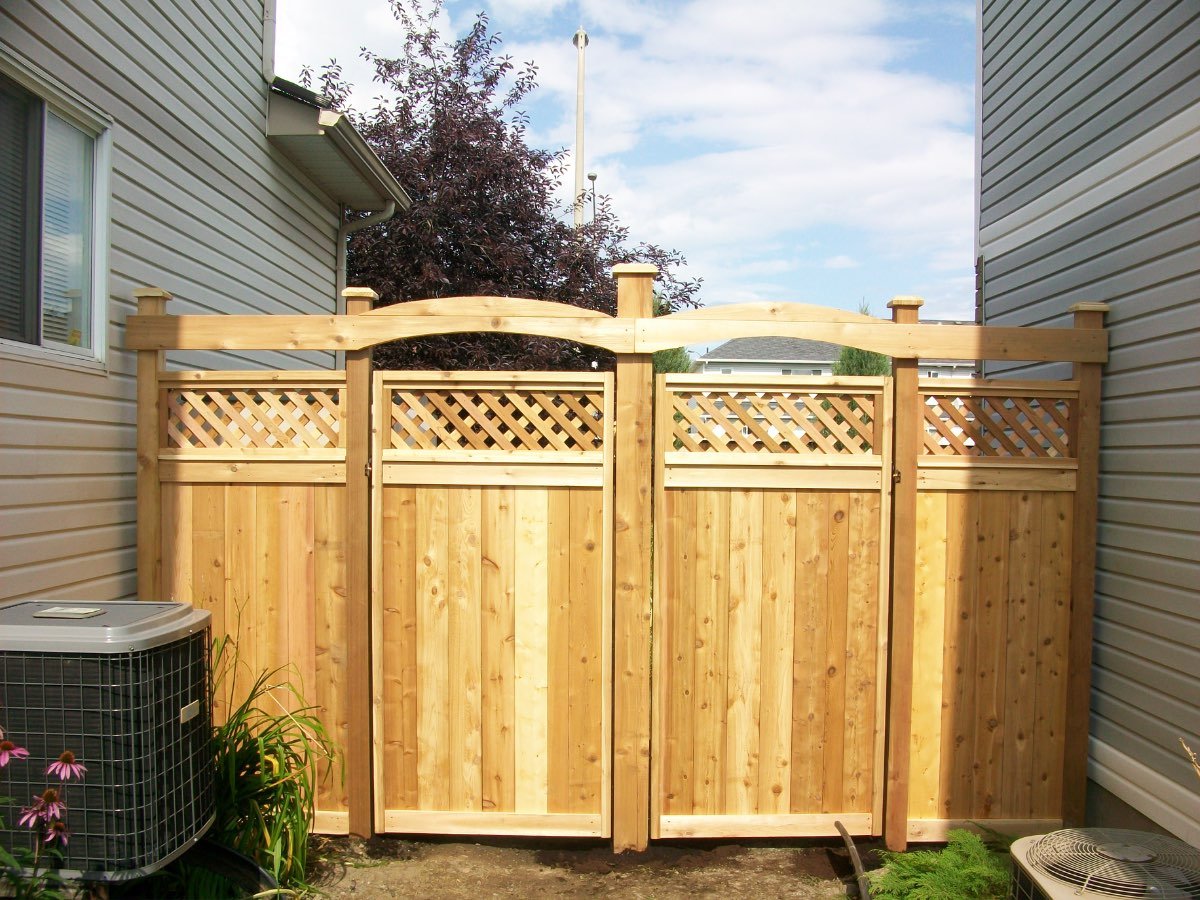

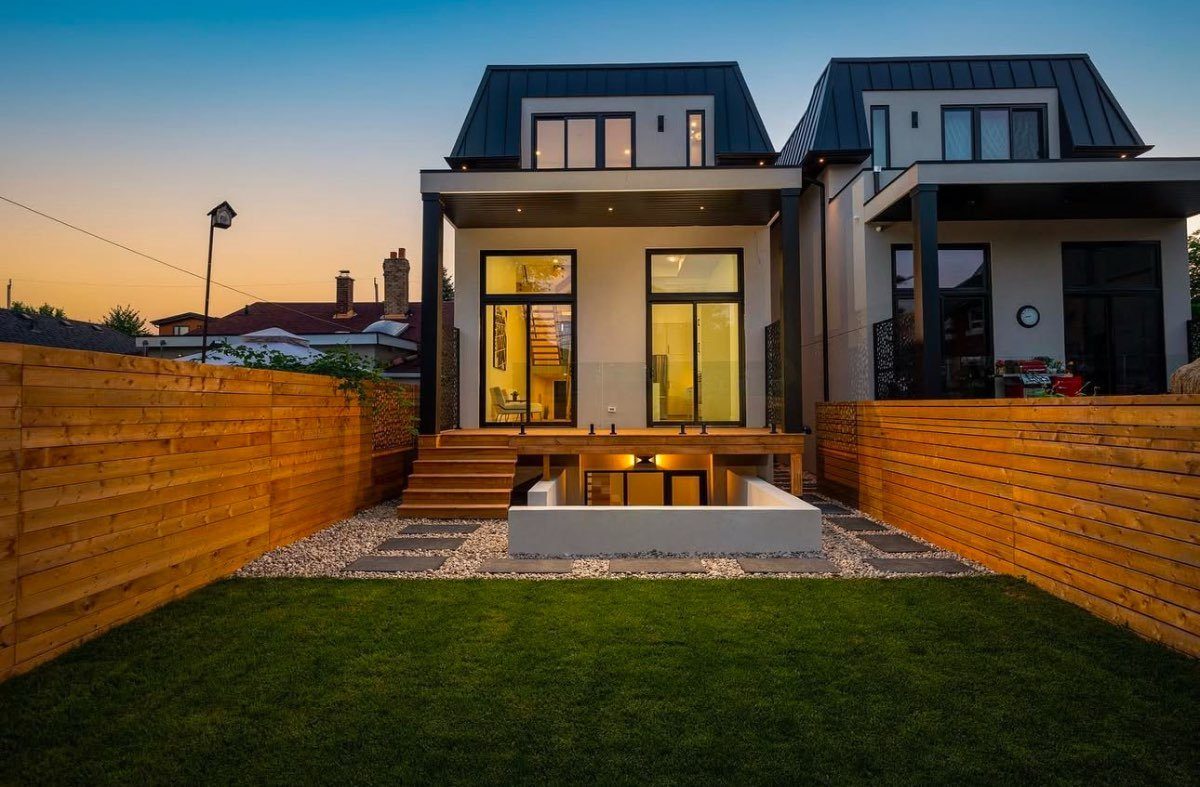
Most stock panels sold in this city are 6 feet, so buying off the shelf gives away about a foot of legal height you are allowed to have. We build privacy fences and gates to the line and the grade of your actual yard, drawn in 3D and AutoCAD before anything is dug, rather than to a stock panel count. The four materials we build in sit side by side on the fence builder in Ottawa: every fencing material we build page.
How tall can a privacy fence be in Ottawa?
213 centimetres in a back or side yard. One metre in a front yard. That is Section 5 of Fence By-law No. 2003-462, and it is the number the whole design has to work inside.
Three allowances in Section 6 that people assume are illegal and are not:
| Element | How far it may exceed the height limit |
|---|---|
| A gate, in a side or rear yard | up to 30 cm over |
| An archway forming part of an entrance | up to a total of 250 cm |
| Decorative caps on structural posts | up to 15 cm over |
On a privacy run those three clauses are the difference between a flat 213 cm wall and a fence with a shape to it. A gate at 243 cm and post caps at 228 cm break up the line without breaking the by-law.
How the height is measured matters more here than on any other fence. Height is taken from the grade at the base, and where the two sides sit at different levels, from the highergrade. Ottawa back yards are rarely level with the neighbour’s. If your yard sits lower than theirs, the fence that measures 213 cm on your side is over height when measured from theirs, and you have less screening than the number suggests. We work this out standing on the line, not at the lumber yard.
Source: City of Ottawa, Fence By-law No. 2003-462. The full clause-by-clause read is on our custom wood fences page, which covers the visibility triangle and the finished-side rule as well.
Can my neighbour put up a 7 foot fence?
In a back or side yard, almost. The limit is 213 cm, a hair under 7 feet, so a full 7-foot fence is just over it, though decorative post caps may go 15 cm higher and a gate 30 cm. You do not get a say in it as long as it sits on their land and inside the by-law. In a front yard, no. The limit there is 1 metre.
Two things soften that. The Fence By-law requires the finished side of the fence to face the neighbouring properties and the street, so you are not left looking at rails and posts. And board-on-board construction, where the boards overlap front and back, gives both parties the same view, which is why we suggest it on a shared line more often than any other build.
Who pays for a fence on the shared line is a separate question. Ontario’s Line Fences Act makes no neighbour pay half automatically, and our page on fencing in Ottawa sets out when its fence-viewers can split the cost.
Solid, board-on-board, shadowbox or lattice: which is actually private
This is the question the shopping shelf on this search is quietly asking on your behalf, and no Ottawa fence page answers it. The material decides upkeep. The panel construction decides privacy.
| Construction | What it looks like | Privacy, straight on | Privacy, from an angle | Wind | Both sides look the same? |
|---|---|---|---|---|---|
| Solid board, boards butted edge to edge on one face | A flat wall | Full | Full | Takes the most load, so it needs the strongest posts | No, one side shows rails |
| Board-on-board, boards overlapped front and back | Textured, with a deep shadow line | Full | Full while the overlap holds | Good. Boards can move without a gap opening | Yes |
| Shadowbox or good neighbour, boards alternating sides with a gap between | Solid from straight on | Full | Partial. You see through it walking past | Best of the four. Air passes through | Yes |
| Lattice or trellis top over a solid base | Solid to about 150 cm, open above | Full at seated and standing height | Partial above the base | Good. The open top sheds load | Yes |
A shadowbox fence is sold as a privacy fence and it is genuinely semi-private. Whether that matters depends on the geometry of your yard. If the neighbour’s patio faces yours square on, shadowbox is fine. If their walkway runs parallel to the fence, they see through it every time they use it. Walk the line and look along it at a shallow angle before choosing, because that is the view the panel has to defeat.
Wood is the only one of the four materials that gives you all of these, because wood is cut on site. Composite, vinyl and aluminium arrive as a manufactured panel in whichever configurations the system offers. That is a real trade-off in wood’s favour, and it is worth saying out loud on a page that sells all four.
Where a privacy fence stops working, and it is not where people expect
A barrier works by breaking the line of sight. That is not a figure of speech. It is how the US Federal Highway Administration specifies acoustic barriers, and the same geometry governs the visual case: “A noise barrier can achieve a 5 dB noise level reduction, when it is tall enough to break the line-of-sight from the highway to the home or receiver.”
Applied to a back yard, the consequence is blunt. A 213 cm fence breaks the sightline of a person standing on the ground next door. It breaks nothing above that line. A second-storey window, a balcony, or a neighbour’s raised deck all sit above any fence Ottawa will let you build, and no legal privacy fence in this city changes that. If being overlooked from above is your actual problem, a fence is not the tool, and we would rather say so at the site visit than sell you 40 metres of cedar that does not solve it.
The version of this that catches our own customers is their own deck.The City’s threshold for a deck building permit is a walking surface more than 600 mm, 24 inches, above the adjacent grade, and plenty of Ottawa decks sit at or above that. Fence height, meanwhile, is measured from grade. So a fence that screens you perfectly while you stand in the yard can put your eye line well above the top rail the moment you sit down on the deck we built you. We plan the fence and the deck together, and where the deck is high we add screening at deck level instead of more fence. Our gallery already carries that answer: a cedar deck with a lit privacy screen on it. Screening that forms part of the deck is not caught by the 213 cm fence limit in the first place.
Source: FHWA, Keeping the Noise Down, and the City’s deck permit conditions, quoted in full on our decks page.
The gap under the fence is where privacy leaks
Ottawa back yards slope. A fence run down a slope gets built one of two ways, and the choice is usually made by the crew without anyone asking you.
Stepped: each panel stays level and the run drops in steps, like a staircase. It looks crisp and formal, and it leaves a triangular gap under every panel, largest at the downhill end of each one.
Racked, sometimes called raked: the rails follow the ground and the pickets stay vertical, so the fence hugs the grade with no gap. It suits a gentle, even slope and it reads less formal.
For sightline alone, ankle-height gaps are a small loss. For everything else they are not:
- For noise, gaps are fatal. FHWA is unambiguous: “Openings in noise barriers for driveway connections or intersecting streets destroy their effectiveness.”
- For pets and small children, a triangular gap at the bottom of a stepped panel undoes the whole reason the fence exists.
- If the fence will ever double as a pool enclosure, a gap is a fail. The City requires that no opening through or under the enclosure pass a 100 mm, 4 inch, spherical object. A stepped run on a slope is exactly how a fence flunks that test.
Where the ground makes a stepped run the right call, the fix is a bottom rail or a kickboard closing the triangle, and it has to be designed in rather than added afterwards. This is the sort of thing the 3D model exists to settle before the first post hole.
Will a privacy fence block noise from the road or the neighbours?
Partly, and much less than the marketing on this subject suggests. Here is the honest arithmetic, from the people who build actual sound walls for a living.
An effective barrier reduces noise 5 to 10 dB, which FHWA describes as “cutting the loudness of traffic noise by as much as one half.” You get about 5 dB the moment the barrier is tall enough to break the line of sight, and roughly 1.5 dB more per additional metre of height after that. Ottawa caps you at 213 cm, so you collect the first 5 dB and almost none of the rest.
Three things follow, and they are worth knowing before you spend the money:
- A solid panel beats a shadowbox for noise by a wide margin, because openings destroy the effect. If sound is the reason you are building, shadowbox is the wrong pick even though it is the more neighbourly one.
- Mass helps. A denser panel does more than a light one, which argues for a solid board or a filled composite system over anything open.
- A fence will not fix highway noise. Real highway barriers run to 8 metres. Yours runs to 2.13.
We would rather set that expectation now than have you measure it in July.
Source: FHWA, Keeping the Noise Down.
Gates: the part of a privacy fence most likely to go wrong
A privacy gate is a heavy, solid panel hung on one edge. Every force acting on it is trying to pull the latch corner toward the ground, and a sagging gate is the single most common fence complaint there is. It is also the part a client touches every day, so it decides how the whole fence feels.
What actually keeps a gate square:
- The gate post, not the gate. A gate post carries a permanent off-centre load that no other post on the run carries. It is a bigger post, set deeper, and on a double gate both of them are.
- Diagonal bracing or a steel frame, which is what stops a wooden gate racking into a parallelogram over its first few winters.
- The width you actually need. Pedestrian, mower-width and vehicle-width are three different builds, not three sizes of one build. Getting a machine into the back yard later, for a pool, a shed or a landscaping job, is worth 30 seconds of thought now.
- Frost. A gate is the first place you notice a post that frost has lifted, because a couple of centimetres of movement stops it latching. Setting posts below the frost line does not on its own stop heave, because the freezing layer grips the sides of a post, not only the bottom.
If the gate forms part of a pool enclosure the rules change, and they are not negotiable. Every gate in a pool enclosure has to be self-closing and self-latching, with the latch at least 1.35 metres, 4 feet 5 inches, above the bottom of the enclosure, and fitted with a lock. The enclosure itself has to be at least 1.5 metres tall, with non-frost-susceptible fence posts written into the construction specification. Vertical board construction is on the City’s accepted list. A horizontal board fence is not, and a horizontal fence also hands a child a ladder. Around water we usually recommend powder-coated aluminium pool fencing, with a privacy run behind it where you want the pool area screened as well as enclosed.
Do I need a permit for a privacy fence in Ottawa?
No, not a building permit. The City lists fences on its Projects not requiring Building Permits page, worded as “Fences (not enclosing a pool)”. Two conditions travel with that exemption:
- An exempt project “must still comply with the Ontario Building Code and any applicable law, such as the Zoning By-law”, and with Fence By-law 2003-462. No permit does not mean no rules.
- The moment the fence encloses a pool, a hot tub, or anything capable of holding 600 mm of water or more, a pool enclosure permit is required. It is required even if the fence is already standing.
Designated heritage buildings and properties inside a Heritage District Overlay are not covered by that exemption, and the City asks owners to confirm with a Building Client Service Centre before starting.
Source: City of Ottawa, Projects not requiring Building Permits. Our fuller write-up is the Ottawa deck and fence permit guide.
Which material makes the best privacy fence, and is vinyl cheaper than wood?
There is no single answer, and the honest version is that the four materials fail differently rather than one of them being better. Compared on the properties that matter for a privacy run specifically, and see the fence builder in Ottawa hub for everything else these four materials do:
| Compared on | Custom wood (cedar, pressure-treated) | Composite | Vinyl | Iron and aluminium |
|---|---|---|---|---|
| Relative cost band | Lowest to mid. Pressure-treated is the cheapest route to a solid, code-compliant privacy run, and cedar sits above it. | Higher up front | Mid to higher | Highest, and it is priced as a safety product |
| Upkeep | Optional. The by-law exempts cedar and treated wood from its paint-or-preserve requirement, so stain on a cycle or let it silver | Wash a couple of times a year. Nothing to stain | Rinse it down. Never painted | Rinse it down, and touch up powder coat if chipped |
| Privacy out of the box | Any construction you want, cut on site | Full, where the system interlocks. Trex publishes “always fully private” for its Seclusions panels | Full, in a solid-panel profile | None by design. Pickets are spaced to keep the sightline open |
| Panel styles available | Solid, board-on-board, shadowbox, horizontal, lattice top | Whatever the system offers | Whatever the system offers | Not applicable |
| Noise performance | Good when solid, poor when shadowbox | Good. The panels are dense and gapless | Good when solid | Effectively none |
| What ends its life | The post at the soil line, from ground contact and frost | Fasteners and the post system rather than the boards | Impact damage, and UV over a long horizon | Coating failure at cut ends, and hardware |
| Road salt near a driveway | Weakest of the four | Good | Best of the four | Good |
| Published manufacturer warranty | None. The lumber is a commodity | Trex publishes a 25-year Residential Limited Warranty on its composite fencing | Varies by system. No warranty can be quoted as ours | Not published |
| Where it wins for privacy | Every construction, awkward angles, lattice tops, and the lowest entry price | A timber look with nothing to refinish, and no gaps | The driveway run and the salt line | It does not. This is the wrong material for privacy |
Is vinyl cheaper than wood?Not up front. Pressure-treated wood is the cheapest way to a solid privacy fence in Ottawa and vinyl sits above it. Vinyl’s argument is what it costs you after year one, not what it costs on day one.
We do not publish a lifespan in years for any of these.A years figure depends on the post detail, the drainage and the exposure of your specific run, and any number printed on a website is a guess dressed as a spec. Trex’s 25 years is a manufacturer’s warranty term on its own product, which is a different and more honest kind of number, and it is theirs rather than ours.
Sources: Trex composite fencing, read 2026-08-24, and Fence By-law No. 2003-462.
What is the cheapest privacy fence, and what does one cost in Ottawa?
The cheapest privacy fence is a pressure-treated solid board run at 6 feet with no gates, and it is cheap for reasons worth understanding rather than just accepting. Six things move the number on any quote, and only one of them is the lumber:
- Linear feet, and how straight the run is. Corners, returns and steps down a slope all add posts, and posts are where the labour is.
- Height. Going from 183 cm to 213 cm is not 16 percent more fence. It is a different post depth and often a third rail.
- Gates. The most engineered part of the fence, and the part you will notice going wrong.
- Grade. A stepped run down a slope costs more than a level one, and closing the triangles adds material.
- What is already there. Removing and disposing of an existing fence is real labour.
- Access. Whether the crew can get material and a machine into the back yard changes the day count.
We are not going to print a per-foot number on this page, because the figure that decides your quote is your yard. You get one honest price against a 3D drawing you have already approved.
When privacy fence work happens in Ottawa
The season is set by the ground, not by the calendar. Post holes need workable soil. Deep-winter frost makes setting a post correctly difficult or impossible, and the first weeks of the thaw turn the top layer to mud before it firms back up.
Privacy fences carry one scheduling quirk the other fence types do not. They are the fence people decide they need in June, once the leaves are out, the neighbours are outside and the problem becomes obvious. That is the busiest point in the year for it. If you already know you want one, the design and the site visit can happen months before the ground is ready, and the drawing is what holds your place in the schedule.
About the photos on this page
Our project gallery is organised by the type of work rather than by neighbourhood or by panel construction, so we do not claim that a particular photo on this page shows a specific Ottawa street or a specific build spec. Rather than attach a location to a project we cannot verify, we are simply not doing it. You can see the full gallery of the work we build, filed by project type.