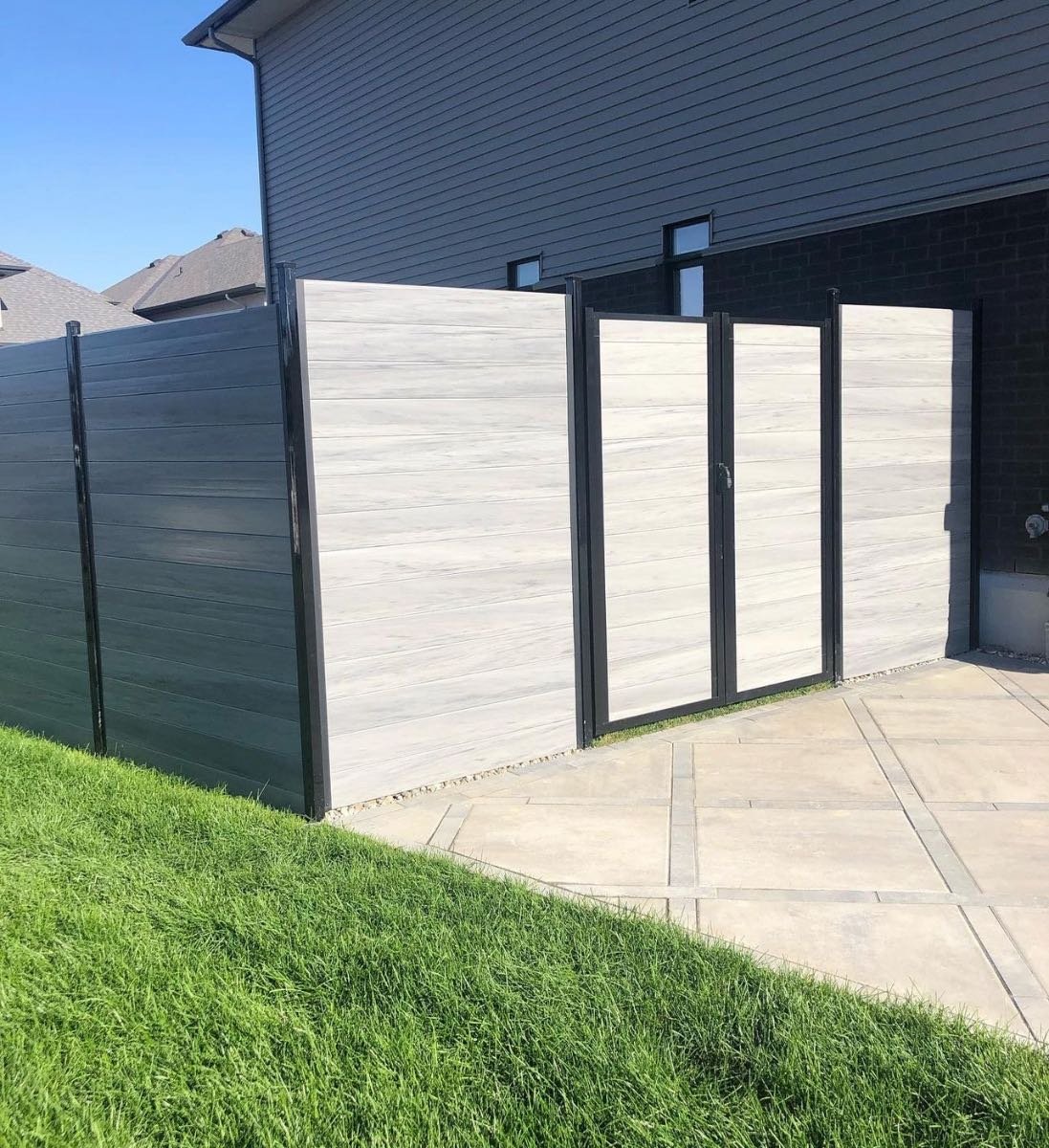

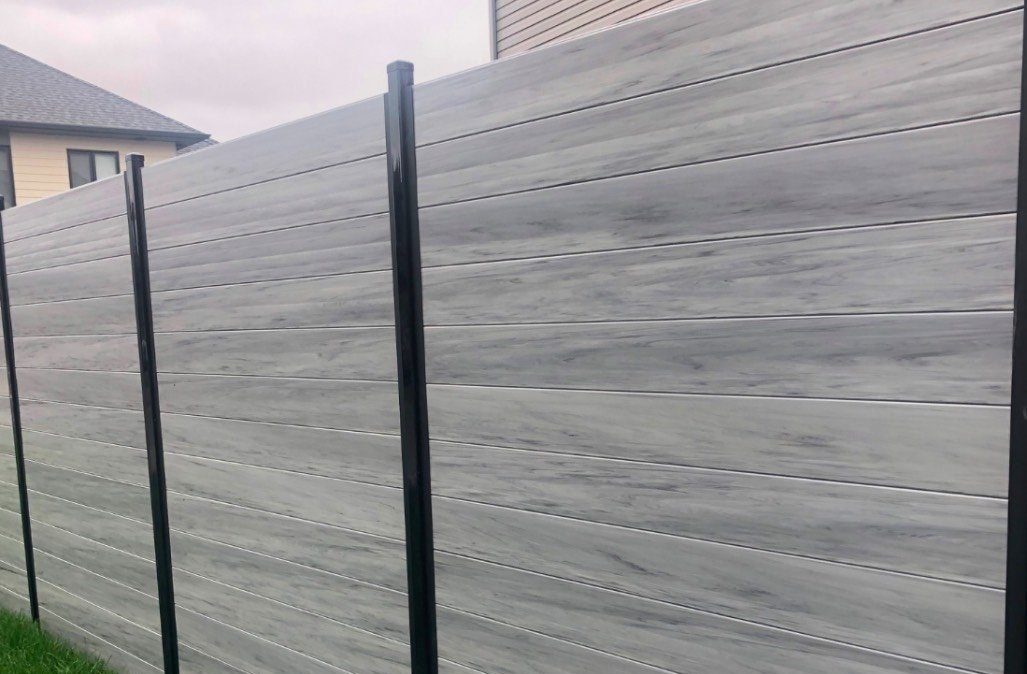
In Ottawa that matters for a reason most product pages skip: the City of Ottawa Fence By-law requires your fence to show its finished side to the street and to your neighbours, and composite panel systems are built to look the same from both sides, so the rule is answered by the material instead of by a design compromise. It also shrugs off the road salt that kills the bottom two boards of a wood fence beside a driveway.
Ottawa Decking Solutions builds composite fences across Ottawa, Kanata, Barrhaven, Orleans, Nepean, Stittsville, Gloucester, Findlay Creek, Vanier and Manotick, and across the river in Gatineau. Call (613) 902-6137.
We are the same crew that builds composite decks. Composite fencing is the same board family standing up instead of lying down, and almost everything we know about how it behaves through an Ottawa winter came from decks first. For the deck itself, our page on composite decking in Ottawa covers the framing composite boards need and how the install-day temperature sets the gap. If you are still choosing between materials, start at every fencing material our fence contractors build, or go straight to the material you are weighing this against: custom wood fences in cedar and pressure-treated, vinyl fencing, or privacy fences and gates if what you want is a screened back yard rather than a particular board.
What a composite fence is, and the one thing it cannot do
The board is a blend of wood fibre and plastic. Trex, one of the lines we build with, states its composite is made from “95% recycled wood and plastic” and that the product “won’t rot, peel or splinter and it never needs painting or staining.”
Here is the part almost nobody selling composite fencing will tell you, quoted from the manufacturer’s own installation guide: “Trex decking cannot be used for structural applications.”
That single sentence is the whole design brief for a composite fence. The boards are a skin. They are not posts, they are not rails, and they will not hold themselves up over an eight foot span. Every honest composite fence is therefore a frame with a composite face: posts and rails carrying the load, boards doing the looking. Trex’s own Seclusions panel system answers it by sitting its interlocking pickets on an engineered aluminium bottom rail rather than on a composite one.
Sources, both the manufacturer’s own: Trex composite fencing for the 95 percent figure and the product claims, and the 2022 Trex Decking Installation Guide (PDF) for the structural sentence. Both read 2026-08-24.
So when you compare a composite quote against a cedar quote, you are not comparing two fences built the same way. You are comparing a clad frame against a fence where the boards are part of the structure. Ask any contractor what carries the load in their composite fence. If the answer is vague, that is your answer.
What the City of Ottawa Fence By-law actually lets you build
Fences in Ottawa are governed by the Fence By-law (No. 2003-462), consolidated with amendments and current to May 9, 2018. It is short, it is public, and it is worth ten minutes before you sign anything.
Read it yourself: City of Ottawa Fence By-law No. 2003-462.
The numbers that decide your project, from the by-law’s own text:
- Height, front yard: one metre (1 m). Section 5(a).
- Height, any yard other than a front yard: two hundred and thirteen centimetres (213 cm). Section 5(b). That is a hair under seven feet, and it is the number that governs the back fence almost everyone is actually asking about.
- Gates may exceed those heights by a maximum of thirty centimetres (30 cm), archways up to 250 cm, and decorative caps on structural posts by a maximum of fifteen centimetres (15 cm). Section 6. That post cap allowance is worth knowing on a composite job, because capped posts are standard on most panel systems and the cap sits above the panel.
- Height is measured from the higher grade where the ground differs on the two sides of the fence. Section 3(b). On a sloped Ottawa lot this is the clause that quietly shortens your fence, and it is the one people discover after the posts are in.
- Visibility triangles. On a corner lot, nothing over seventy-five centimetres (75 cm) within a triangle measured three metres along the lot lines. And on any lot, the same 75 cm limit within a triangle measured two metres along the lot line and the driveway. Section 4. Read that second one twice. It is not a corner-lot rule. If your fence runs to the street beside your own driveway, it applies to you.
Two more clauses that a composite buyer specifically should know.
The finished side has to face out.Section 15 requires a fence to be “constructed and finished in such a manner so as to present the finished side thereof, toward the public street and the neighbouring properties.” The by-law defines finished side as either both sides having the same appearance, or the outward side being “free of evidence of structural components, such as posts.” Composite panel systems are commonly built to present the same face on both sides, which satisfies the first branch of that definition by design. A board fence answers the same rule by hiding its rails, which costs framing detail and sometimes costs you the good side.
And the maintenance duty.Section 12(d) requires every fence to be kept “protected by paint, preservatives or other weather-resistant material, except for wooden fences made of cedar, redwood or treated wood.” Composite is a weather-resistant material by construction, so there is nothing to reapply. Note that the exemption list names three woods and was drafted in 2003, so composite is not in it by name. We read that as a material that satisfies the requirement rather than one that is excused from it, and we are contractors rather than lawyers: if the distinction matters to you, ask By-law Services.
On permits: the Fence By-law contains no permit provision. There is no fence permit clause anywhere in its thirty-two sections. What it contains instead is Section 25, a general prohibition on erecting or maintaining any non-compliant fence, and Section 26, which makes a contravention an offence. The exception is pools. Section 13(c) forbids erecting a fence in a manner that renders a swimming pool enclosure non-conforming with the Pool Enclosure By-law (No. 2013-39), which is a separate instrument with its own requirements. If a pool is in the picture, that is the iron and aluminium pool fence conversation, not this one. Our full write-up of deck and fence approvals is in the Ottawa deck and fence permit guide.
The height and visibility-triangle limits do not change with the material. They bind the wood, vinyl and aluminium runs our fence contractors in Ottawa build exactly as they bind composite.
Freeze-thaw, road salt, and what the winter actually does to it
Ottawa gives a fence two separate problems, and composite handles them differently.
Salt.The bottom courses of a wood fence beside a driveway or a sidewalk take a winter of splash: brine off the road, plough spray, and whatever went down on the walk. Wood drinks it. Composite does not, and the manufacturer says so in the context of the harshest test it publishes. Trex’s care guidance states that “calcium chloride or rock salt, available in many home centers, will melt ice on Trex decking” and asks only that you “rinse off when first practical.” That is ice melt applied directly to the surface, deliberately, as the recommended method. A fence never gets treated that aggressively.
Source: Trex care and cleaning, read 2026-08-24.
Be precise about what that citation covers, because we are not going to overstate it. Trex publishes that guidance for its decking, and its care and cleaning page carries no fencing section at all. It tells you what the material tolerates. It is not a fence specification.
Freeze-thaw. Composite does not rot and does not absorb water the way a board does, so the classic freeze-thaw failure of a wood fence, water in the grain expanding and splitting the board, is not the failure mode here. The freeze-thaw problem for a composite fence moves underground, to the posts. That is a framing and footing question, and it is identical to the one on a cedar fence: posts set below the frost line, though depth alone does not stop heave, because frozen clay grips the sides of a post.
The Ontario Building Code’s minimum-depth-of-foundations rule is often quoted at homeowners here as though it settled the question. It does not, and the reason is worth knowing. That section governs the foundations of buildings, heated and unheated, and a fence is not a building. The Fence By-law itself defines a fence as “any freestanding structure, wall or barrier other than a building.” So there is no code-mandated fence post depth to point at. Setting posts below frost is engineering practice and it is what we do, not a number the City hands you. Anyone quoting you a legally required fence post depth in Ottawa is quoting something that does not exist.
The 4.4 degree rule nobody mentions in the quote
This is the most Ottawa-specific thing about building in composite, and it is genuinely material-specific: composite boards are gapped differently depending on how cold it is on the day they go in.
From Trex’s own decking installation guide, the gaps are given in two columns, above and below 40 degrees Fahrenheit, which is 4.4 degrees Celsius:
| Gap | Installed above 4.4 °C | Installed below 4.4 °C |
|---|---|---|
| Board end to end | 1/8 in. | 3/16 in. |
| Board abutting a fixed object | 1/4 in. | 1/2 in. |
Source: 2022 Trex Decking Installation Guide (PDF), gapping and overhang pages, read 2026-08-24. The guide gives the threshold in Fahrenheit, as above and below 40 F.
The gap doubles in the cold. The board is going to grow when the sun comes back, and if it was fitted tight on a cold morning it has nowhere to go.
Now put an Ottawa calendar next to that threshold. 4.4 °C is not a deep-winter number. It is an early-April-morning number and a late-October-afternoon number. A crew working the shoulders of the season can cross that line inside a single working day, which means the correct gap is a decision made on site with a thermometer, not a spec written once in an office. It is also why a composite fence thrown up fast in cold weather can look wrong by July.
Again, the honest boundary. Those figures are published for Trex decking, not for a fence panel system, and any panel kit carries its own instructions that take precedence. The point that survives is the principle, which is true of every composite board on the market. This material moves with temperature and the installer has to account for the temperature on the day.
Composite against the other three, honestly
We build all four fence materials and we do not have a house favourite. What follows is the comparison we would give you at the site visit.
| Compared on | Composite | Custom wood (cedar / pressure-treated) | Vinyl (PVC) | Iron & aluminium |
|---|---|---|---|---|
| What it asks of you | Wash it. Trex advises soap, water and a soft-bristle brush, and semi-annual cleaning in spring and fall to stop debris building up. Nothing to stain or seal. | Cleaning and refinishing on a cycle. Left alone, cedar greys. By-law s.12(d) exempts cedar, redwood and treated wood from the “paint or preservatives” duty, so weathering it is legal, not merely tolerated. | Rinse it down. No painting. | Powder coat, so effectively nothing. |
| Manufacturer warranty | Trex publishes a 25-year Residential Limited Warranty on its composite fencing. | Wood carries no product warranty of that kind. | Varies by manufacturer. Not sourced here. | Varies by manufacturer. Not sourced here. |
| What carries the load | A frame. The boards are explicitly non-structural per the manufacturer. | The boards and rails together. Wood is the structure. | A frame, same as composite. | The pickets and rails themselves. |
| Fence By-law finished-side rule (s.15) | Answered by the material on systems built to look the same both sides. | Answered by framing detail. Costs design attention, and sometimes costs you the good side. | Usually answered by the material. | Answered by the material. Open pickets have no bad side. |
| Colour over time | Consistent along the whole run. Nothing to patch as it ages. | Changes, and changes unevenly where sun and splash differ. | Consistent. | Consistent. |
| Where it wins in Ottawa | A long run beside a driveway or sidewalk that takes salt, on a property where nobody wants a refinishing weekend. | Warmth, on-site cutting for awkward angles and grade, and the lowest entry cost. | A clean uniform line at low upkeep. | Pool enclosures, and any sightline you do not want to block. |
Sources for the composite column: Trex composite fencing for the 25-year Residential Limited Warranty, and Trex care and cleaning for the washing guidance. Both read 2026-08-24. The by-law rows are Fence By-law No. 2003-462.
There is no cost row in that table, and that is deliberate. Ottawa Decking Solutions does not publish a fence price list, and we are not going to put a made-up number on this page so it looks complete. Two things make a published band misleading anyway. A composite fence quote is driven by run length, post count, gates, grade changes and what has to come out first, none of which a per-foot figure captures. And the panel prices you will find on a Google Shopping result are material at retail, which is not an installed fence and never has been. What we do publish is a real installed cost band for decks, because we have one: what a deck costs in Ottawa.
When to build a composite fence in Ottawa
The ground decides, the same as it does for a deck. Posts have to go below frost, and deep winter ground is frozen hard enough that digging and setting posts properly is difficult or impossible. Once the thaw starts, the top layer turns to mud before it firms back up. That leaves a real window each year where the ground can be worked, and it is the same window every deck, fence and interlock crew in the city is booking into, so spring fills up fast across the whole trade.
Composite adds one wrinkle to that calendar which wood does not have: the 4.4 °C gapping threshold above. A composite fence built in the cold shoulder of the season is not a worse fence, but it is a fence where the installer has to be paying attention on the day.
The useful move is to do the parts that do not need thawed ground while the ground is still frozen. Design, material choice, colour, gate positions, the by-law check on your specific lot, and the property-line conversation can all be settled in February so the build starts the week conditions allow. We design every project in 3D and AutoCAD before anything is cut, and that drawing is what makes an off-season decision possible.
Common questions
What are the downsides of composite fencing?
Three real ones. It costs more up front than pressure-treated wood. The boards are not structural, which the manufacturer states plainly, so a composite fence is only as good as the frame behind it and a cheap frame is a hidden defect you will not see for years. And it moves with temperature, which is why the gap changes at 4.4 °C on install day. A fourth thing people call a downside is really a preference: composite is uniform, and if you want a fence that weathers and changes, cedar is the one that does that.
What are some common problems with composite fencing?
The ones we actually see are installation problems rather than material problems. Boards fitted tight on a cold day and then buckling in July, which the gapping table above exists to prevent. Posts that were not set below frost, which shows up as a wavy line after the first hard winter. And surface scratching from careless snow clearing, which is worth knowing because Trex says directly that “a shovel may scratch the deck, which is not covered under warranty.” Nothing on that list is rot, because there is no rot. Trex care and cleaning, read 2026-08-24.
What is the average cost of composite fencing in Ottawa?
We do not publish an average, and you should be sceptical of a contractor who does before seeing your yard. The honest version of the answer is that composite sits above wood at the start and asks for nothing afterwards, and which of those matters more depends on how long you are staying in the house. That is a five minute conversation at the site visit, with numbers attached to your actual run length.
Is composite fencing expensive?
Compared to pressure-treated wood on day one, yes. Over the life of the fence the comparison changes, because the wood fence has a refinishing cycle attached to it and the composite fence does not. Trex publishes a 25-year Residential Limited Warranty on its composite fencing, which is the manufacturer’s own statement about how long it expects the product to hold up. That is a product warranty from Trex, and it is a separate thing from our workmanship warranty on the installation.
Do you need a permit for a fence in Ottawa?
The City of Ottawa Fence By-law No. 2003-462 contains no permit provision. It sets heights, visibility triangles, construction standards and the finished-side rule, and it makes a non-compliant fence an offence. Pools are the exception and are governed separately by the Pool Enclosure By-law No. 2013-39. Designated heritage buildings and properties inside a Heritage District Overlay are not covered by the City's building permit exemptions, and the City asks owners to confirm with a Building Client Service Centre before starting. Thresholds and by-laws do change, so we confirm the current rules for your specific property rather than relying on what a neighbour built, and we handle the by-law setbacks and any drawings as part of the build.
How tall can a composite fence be in Ottawa?
213 cm in a back or side yard, and 1 m in a front yard, measured from the higher grade where the two sides differ. Gates may go 30 cm above that and decorative post caps 15 cm above it. If your lot is a corner lot, or if the fence runs to the street beside your driveway, the 75 cm visibility triangle rule cuts in, and it is measured from the intersection rather than from the fence.
Does composite fencing handle road salt?
Better than wood does, which is the main reason it gets specified for the run beside a driveway. Trex publishes calcium chloride and rock salt as the recommended way to melt ice on its decking, with a rinse when practical. Wood in the same position absorbs the brine and the bottom courses go first.
About the photos on this page
Our project gallery is organised by type of work, decks, fences, interlock and outdoor structures, and it is not tagged by material or by neighbourhood. So this page does not claim that any particular photo is a composite fence we built at a named address. Rather than attach a description to a project we cannot verify, we are not doing that. What you can see is our full gallery of the work we build. As we tag projects properly, verified composite fence photos will replace the general link.