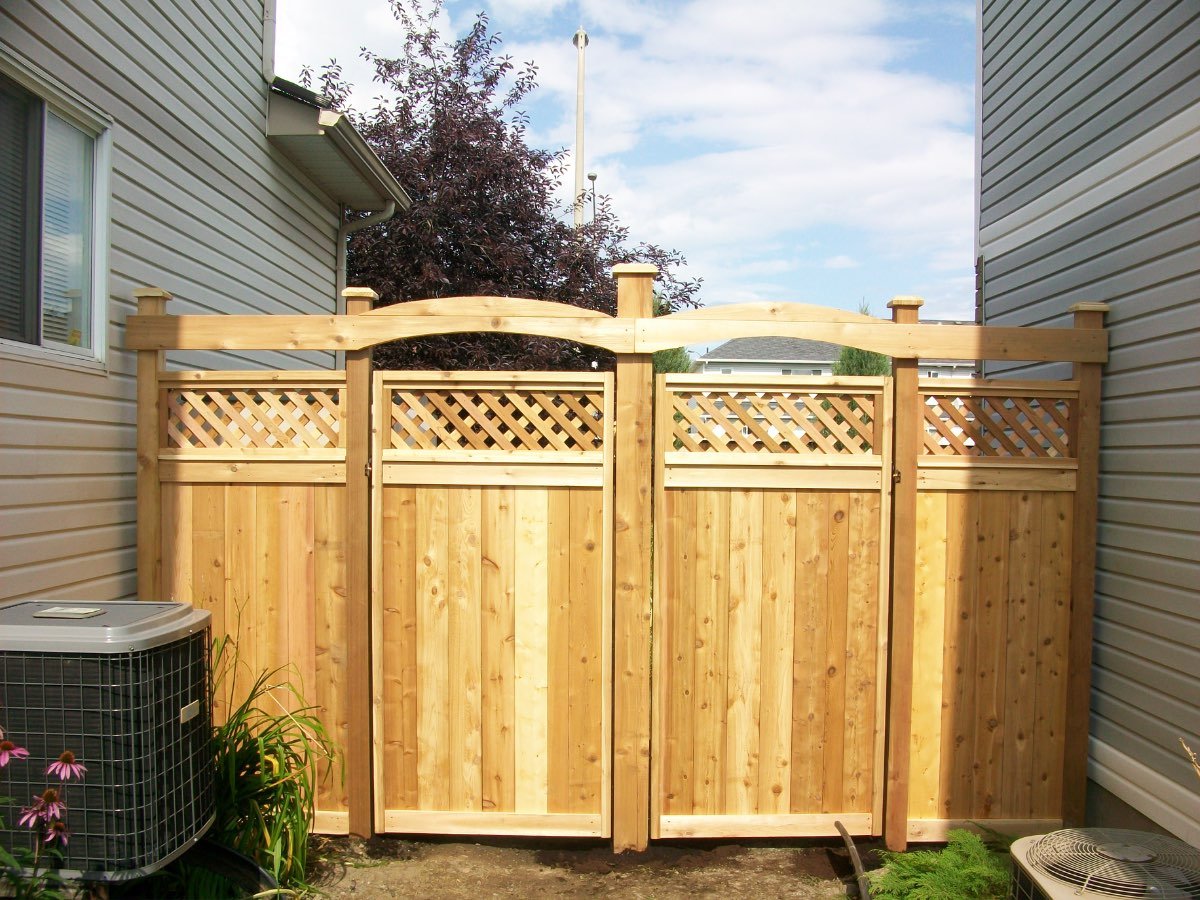

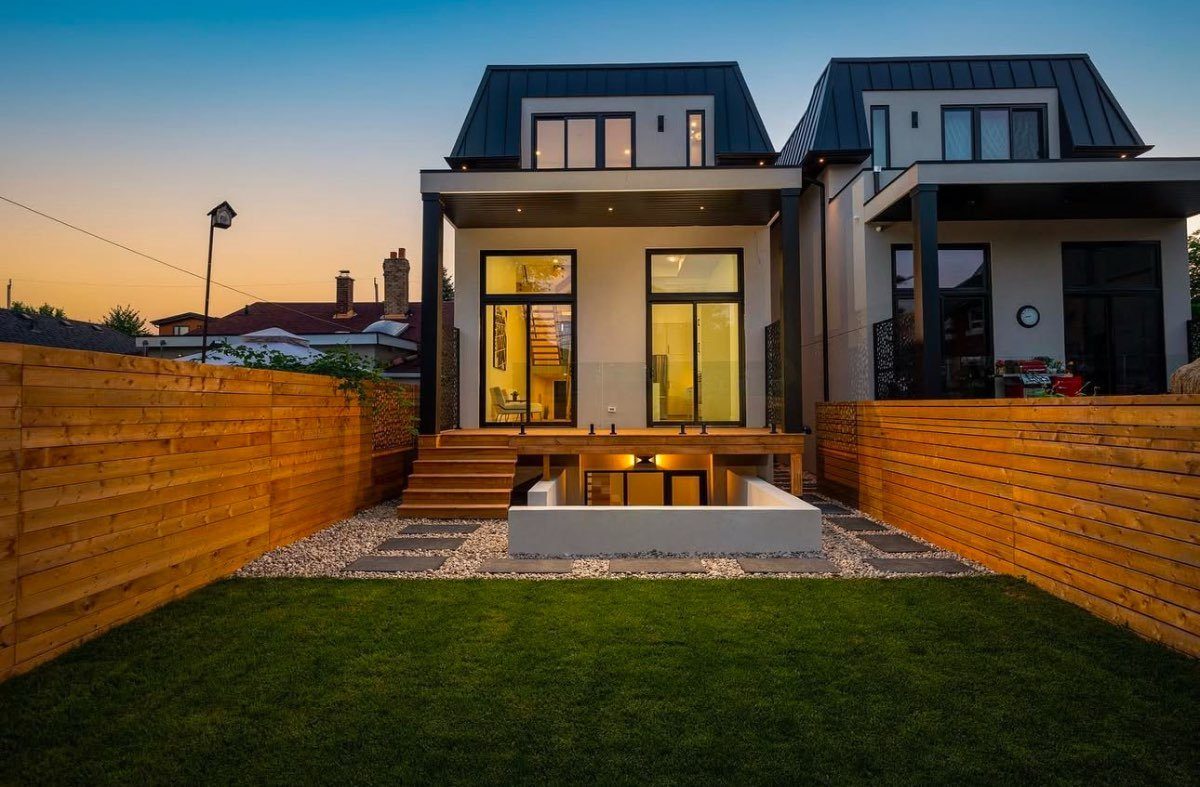
Height is measured from the higher grade where the two sides of the fence sit at different levels. The finished side has to face the street and your neighbours. We build custom wood fences and gates across Ottawa, drawn in 3D and AutoCAD before anything is dug. Wood is one of four materials we build in, and the fence builder in Ottawa: every fencing material we build page sets them side by side.
What Ottawa actually lets you build
Fence By-law 2003-462 is short and it is specific, and knowing four of its clauses saves most of the arguments that happen after a fence is up.
Height. Section 5 caps a residential fence at one metre in a front yard and 213 centimetres in any other yard. Section 6 then gives three allowances people usually assume are illegal: a gate may exceed the limit by up to 30 cm, an archway over an entrance may reach 250 cm, and decorative caps on structural posts may sit 15 cm proud of the top. On a cedar fence those three clauses are the difference between a flat run and a fence with a shape to it.
How the height is measured. Section 3 says the height is taken from the grade at the base, and where the two sides of the fence sit at different levels, from the higher grade.Ottawa back yards are rarely level with the neighbour’s. If your yard sits lower, the fence that is 213 cm on your side can be over height when it is measured from theirs. We work this out at the site visit rather than at the lumber yard.
The visibility triangle, which is the one that catches people. Section 4 has two parts, and the second applies to any lot, not just a corner. Nothing over 75 cm may stand inside a triangle formed by measuring 2 metres along your lot line and along your driveway at the point they meet the street. On a corner lot the triangle is bigger: 3 metres along both lot lines. A solid privacy run that carries straight through to the sidewalk beside the driveway is a common and expensive mistake.
Which way the fence faces.Section 15 requires that a fence “present the finished side thereof, toward the public street and the neighbouring properties.” A board fence has a good side and a rail side, so this clause is only ever about wood. Good-neighbour board-on-board construction, where the boards alternate sides, answers it and gives both parties the same view. Board-on-board, shadowbox and lattice tops are covered properly on our privacy fences and gates page, along with the gates that go with them.
Do you need a permit to put up a fence in Ottawa?
No, not a building permit, and the City says so in a list rather than in a judgement call. Its “Projects not requiring Building Permits” page names, verbatim:
Fences (not enclosing a pool - see Pool Enclosure By-law 2013-39)
Two things travel with that. The same page notes that an exempt project “must still comply with the Ontario Building Code and any applicable law, such as the Zoning By-law”, so exempt from a permit is not exempt from the rules above. And the moment the fence encloses a pool, a hot tub or anything holding 600 mm of water, a pool enclosure permit is required, even if the fence is already standing.
Designated heritage buildings and properties inside a Heritage District Overlay are not covered by that exemption, and the City asks owners to confirm with a Building Client Service Centre before starting.
Source: City of Ottawa, Projects not requiring Building Permits. Our fuller write-up is in the Ottawa deck and fence permit guide.
The one clause in the by-law that is only about wood
Section 12 lists what every fence owner has to keep up: good repair, safe and structurally sound, free from accident hazards, and “protected by paint, preservatives or other weather-resistant material, except for wooden fences made of cedar, redwood or treated wood.”
Read that exception carefully, because it is doing real work. The City has written into its own by-law that cedar and pressure-treated lumber are durable enough to be left unfinished. If you want a cedar fence to weather to silver and never touch it again, nothing in Ottawa’s by-law obliges you to stain it. That is a legitimate choice here, not neglect.
What the exception does not do is release the fence from the other three parts of Section 12. A cedar fence still has to be in good repair and structurally sound. Weathering is allowed. A leaning run with split boards is not.
The post is what fails, and the standard that governs it
A wood fence almost never dies from the top down. The boards grey, cup and split, and they are the cheap part. What ends the fence is the post, because the post is the only piece with a leg in the ground, and ground contact is a completely different exposure from anything above it.
Canada has a standard for exactly this. The CSA O80 Series is referenced in the National Building Code and in the provincial codes, and it sorts treated wood into use categories by how wet and how buried the piece will be:
- UC3 covers exterior construction not in ground contact. That is your rails, your boards and your cap. UC3.2 is the sub-category for uncoated products or poor water run-off, which is what a fence board actually is.
- UC4 covers exterior construction in ground or fresh water contact. That is your post, and nothing else on the fence.
The failure mode is buying one grade of lumber for the whole job. A UC3 post in a UC4 hole rots from the inside at the soil line and gives you a fence that looks fine and pushes over in a wind. The retention and penetration of preservative required is different between the two categories, and it is stamped on the wood. Cedar is the same argument in a different form: cedar heartwood is naturally durable, cedar sapwood is much less so, and in the ground that distinction starts to matter.
Freeze-thaw is a post problem, not a board problem
Ottawa runs through dozens of freeze-thaw cycles a year, and what that does to a fence is lift it. Water in the soil freezes, expands, grabs the post and jacks it upward. It does not come all the way back down in spring, so the damage accumulates: the line goes out of true, the gate stops latching, and the panels start to rack.
Setting posts below the frost line does not on its own stop this, because the freezing layer grips the sides of a post, not only the bottom. Ottawa’s depth is not one number for the whole city, because it depends on soil type, drainage and what is under the yard, so we determine it on site rather than quoting a figure that would be wrong on half of these lots. The same rule the City works from for a foundation says it in six words: below the frost line, or to solid rock. In parts of the west end the limestone is close enough to the surface that the second answer is the one that applies.
This is also why the season has a shape here. Post holes need workable ground. Deep-winter frost makes digging and setting a post correctly difficult or impossible, and the first weeks of the thaw turn the top layer to mud before it firms back up. So the window is not a date on a calendar, it is the state of the ground.
Road salt, and where wood is genuinely the wrong choice
A fence running along a driveway or close to a City sidewalk takes salt spray all winter, thrown by your own car and by the plough. Salt does not rot wood the way water does, but it stays in the wood, it pulls moisture back in, and it is hard on fasteners and hardware at exactly the height where spray lands.
We would rather say this plainly than sell a cedar fence into the wrong spot. On the driveway edge and the street-side run, vinyl, composite and powder-coated aluminium beat wood, and they are the same four materials we build in, so there is nothing to lose by mixing them. Plenty of Ottawa yards end up with a cedar privacy line across the back and a different material on the driveway side, and that is a better fence than either material used everywhere.
If that is the argument you are having, our vinyl fences page covers the salt-and-driveway case and composite fences covers the same low-upkeep argument in a board that still reads as timber.
Wood against the other three, honestly
Compared on the properties that decide a fence rather than on price, and see the fence builder in Ottawa: every fencing material we build hub for everything else these four materials do:
| Compared on | Custom wood (cedar, pressure-treated) | Composite | Vinyl | Iron and aluminium |
|---|---|---|---|---|
| Relative cost band | Lowest to mid. Pressure-treated is the cheapest way to a solid, code-compliant fence; cedar sits above it. | Higher up front | Mid to higher | Highest, and it is the only one priced as a safety product |
| Upkeep | Optional. By-law Section 12 exempts cedar and treated wood from the paint-or-preserve requirement, so you may stain on a cycle or let it silver | Wash a couple of times a year, nothing to stain | Rinse it down, never painted | Rinse it down; touch up powder coat if chipped |
| What ends its life | The post at the soil line, from ground-contact decay and frost movement. Boards are replaceable and cheap | Fasteners and post system rather than the boards | Impact damage and UV over a long horizon | Coating failure at cut ends and hardware |
| Colour over time | Changes. Cedar silvers, stained wood fades between coats | Stays even along the whole run | Uniform, never repainted | Uniform |
| Road salt near a driveway | Weakest of the four | Good | Best of the four | Good |
| Can it be a pool enclosure? | Yes, if built vertical-board to By-law 2013-39, or as an equivalent the City accepts | Only if it meets 2013-39 | Yes, vinyl is a named construction type | Yes, and it is what we recommend most often |
| Where it wins | Warmth, on-site cutting for awkward angles, board-on-board privacy, lattice tops, and the lowest entry price of the four | Timber look with none of the refinishing | The driveway run and the salt line | Around water, and anywhere you want the sightline kept open |
We do not publish a years figure for any of these. A lifespan number depends on the post detail, the drainage and the exposure of the specific run, and any figure printed on a website is a guess dressed as a spec. We will tell you what we expect from your fence, on your line, at the site visit.
If the wood fence is going to enclose a pool, everything changes
This is the one case where a wood fence stops being a by-law question and becomes a permit application. Pool Enclosure By-law No. 2013-39 applies to any outdoor pool, including a hot tub, capable of holding 600 mm of water or more.The City’s own guide is blunt about the sequence: if you already have a fence around the yard and you put a pool in, you still have to apply for a pool enclosure permit.
What it requires, and the parts that bear on a wood build specifically:
- At least 1.5 metres, about 5 feet, in height. That is well under the 213 cm ceiling on an ordinary fence, so a compliant pool fence is legal as a fence too.
- Vertical board construction is one of the named accepted constructions, alongside chain link with mesh no larger than 38 mm, and wrought iron, aluminium or vinyl. A horizontal board fence is not on that list, and it also gives a child a ladder. The by-law does allow a fence “that provides an equivalent enclosure as detailed in the by-law”, so a horizontal design is a conversation with Building Code Services before it is a design decision, not after.
- No opening through or under the enclosure may pass a 100 mm sphere. On sloped ground that is the gap under the bottom rail, and it is where wood fences fail this test.
- “Fence posts are non-frost susceptible” is written into the construction specifications. The frost detail is not optional here, it is inspected.
- Gates must be self-closing and self-latching, with the latch at least 1.35 metres, about 4 feet 5 inches, above the bottom of the enclosure, and fitted with a lock.
- A grading plan is required where the pool is an inground pool, or where the pool and its surrounding apron sit within 1.2 metres, 4 feet, of the property line. The City applies that in both rural and urban areas, and asks for two copies with the application.
Source: City of Ottawa, Pool enclosures and the City’s Pool Enclosure Guide (PDF).
Around water we usually recommend powder-coated aluminium pool fencing instead, because it meets the picket spacing without a design argument and keeps the sightline to the pool open. Wood is the better answer where you want the pool area private rather than visible.
How much does a wood fence cost in Ottawa?
We are not going to print a per-foot number, because the figure that decides your quote is not the lumber. Six things move it:
- Linear feet, and how much of the run is straight. Corners, steps down a slope and returns all add posts.
- Height. A 213 cm fence is not 30 percent more material than a 180 cm fence, it is a different post and a different rail count.
- Gates. A gate is the most engineered part of a fence and the part most likely to be the thing you notice going wrong. Pedestrian, mower-width and vehicle-width are three different builds.
- Grade. A stepped fence down a slope costs more than a level run and looks better than a racked one.
- What is already there. Removing and disposing of an existing fence is real labour.
- Access. Whether the crew can get material and a machine into the back yard changes the day count.
Those six factors set the price of a vinyl, composite or aluminium fence too. If you want a published starting point, the page for our Ottawa fence buildersanswers the average-cost question with HomeStars’ Ottawa figures for each material, credited to HomeStars and not quoted as ours.
About the photos on this page
Our project gallery is organised by the type of work rather than by neighbourhood or by material detail, so we do not claim a specific photo on this page shows a particular Ottawa street or a particular build spec. Rather than attach a location to a project we cannot verify, we are simply not doing that. You can see the full gallery of the work we build, filed by project type.