

Updated October 2026
On this page
- What types of fences are there, and which do we build?
- Which fence suits which part of an Ottawa yard?
- Why does an Ottawa winter matter more than the material?
- Which fence lasts longest, and which needs the least upkeep?
- What type of wood is best for a fence?
- Wood or metal, vinyl or composite?
- What is the cheapest fence, and the easiest to install?
- Do you need a permit to put up a fence in Ottawa?
- Fences across the river in Gatineau
- How we help you choose
- Common questions
Most Ottawa yards are best served by more than one fence material. Wood, cedar or pressure-treated, is the classic back-line privacy fence, and pressure-treated is the cheapest solid one. Vinyl, composite and powder-coated aluminium handle the salt on the driveway side.
Around a pool we recommend aluminium most often: the by-law names it, and you can watch the water through it.
Ottawa adds its own tests to the catalogue. Fence By-law 2003-462 sets a height for each yard and a finish rule for wood, the Pool Enclosure By-law names the fence types it accepts, and the winter brings wind, drifting snow and road salt. Below, each part of the yard gets the fence that suits it, with the rule behind the choice.
What types of fences are there, and which do we build?
Five families of fence cover the realistic choices for an Ottawa backyard. We build four of them: wood, composite, vinyl, and aluminium or iron. We do not install the fifth, chain link, but it is a fair choice for some yards, and the City has a rule about it.
Wood and composite
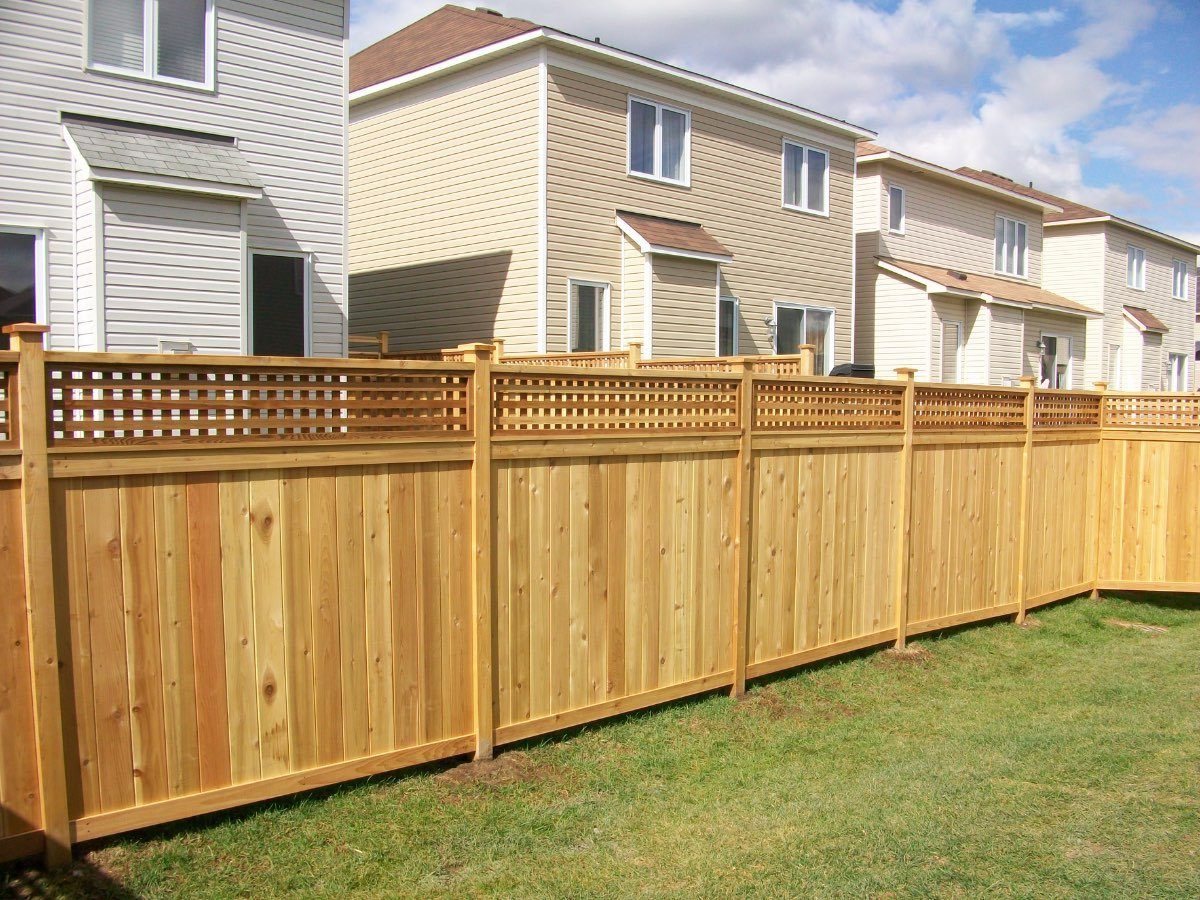
Wood means cedar or pressure-treated lumber, built board by board on site, so it can follow any angle or slope on the day. It is also the one material the by-law lets you leave bare by name.
Section 12 requires a fence to be protected by paint, preservative or another weather-resistant finish, and exempts wooden fences of cedar, redwood or treated wood. Our page on custom wood fences covers the grades.
Composite is a board of wood fibre and plastic hung on a frame. Trex, one of the lines we build with, says in its decking installation guide that the boards cannot be used for structural applications, so posts and rails carry the load and the composite is the face. It never needs stain. Our composite fences page goes further.
Vinyl, aluminium and iron
Vinyl is rigid PVC profile: posts, rails and panels made to slot together. Its standard, ASTM F964, tests the profile for impact and weathering and says in its own scope that it does not cover wind load on the fence. How a vinyl fence stands up is decided by how it is installed. Our vinyl fences page explains the spec worth asking about.
Aluminium and iron are picket fences: slim bars between rails, finished in powder coat. Aluminium does not rust. Steel and wrought iron will, wherever the coating chips. Both keep the view open, which suits a pool and defeats a privacy fence. See iron and aluminium pool fences.
Chain link, and the rules that name each type
Chain link is steel mesh woven between steel posts. HomeStars' Ottawa price guide prices it lowest of the five. At a house in Ottawa, section 18 of the Fence By-law requires it to be vinyl or powder coated, so bare galvanized mesh is out. It suits a dog run or a back lot line where privacy does not matter.
| Fence type | Fence By-law 2003-462 | As a pool enclosure (By-law 2013-39) | Do we build it? |
|---|---|---|---|
| Cedar or pressure-treated wood | May be left unfinished: s.12 exempts cedar, redwood and treated wood from the finish rule. Any other wood must be painted or sealed | s.29, vertical board: boards at least 25 by 100 mm, gaps of 38 mm at most, posts at least 100 by 100 mm and no more than 2.4 m apart | Yes |
| Composite | Not named. Its finish is built in, which we read as the weather-resistant material s.12 asks for | Not named in ss.28 to 30. The Chief Building Official decides at the permit stage, and s.27 lets the City approve an equivalent enclosure | Yes |
| Vinyl (PVC) | Not named | s.30, with wrought iron and aluminium: no opening that passes a 100 mm sphere, posts no more than 3 m apart, 1.2 m clear between the rails | Yes |
| Aluminium or iron | Not named | s.30, the same section as vinyl | Yes |
| Chain link | s.18: on residential property it must be vinyl or powder coated | s.28: mesh no larger than 38 mm, end and corner posts at least 48 mm, posts no more than 3 m apart | No |
Source: City of Ottawa, Fence By-law No. 2003-462 · City of Ottawa, Pool Enclosure By-law No. 2013-39 (PDF)
Which fence suits which part of an Ottawa yard?
Start with the yard and choose the material second. One lot can need a low open fence at the street, a salt-proof run beside the driveway and a solid privacy line across the back, and the by-law treats each of those spots differently.
The front yard
Section 5(1) caps a residential fence at 1 metre in the front yard. A front gate gets no extra height: the 30 cm gate allowance in section 6 applies in side and rear yards only. At 1 metre a fence marks the line and keeps a small dog in, so an open picket in aluminium, vinyl or wood usually sits better on a street than a short solid wall.
Where the driveway meets the street, section 4(2) adds a triangle measured 2 metres along the lot line and 2 metres along the driveway. Nothing in it may stand above 75 cm, whatever it is made of.
The driveway side and the street edge
Salt decides this run. Brine off your own tires and spray from the plow land on the bottom of the fence all winter. Vinyl, composite and powder-coated aluminium take it without rotting or rusting, so we steer the driveway run away from wood even on a lot where the back fence is cedar.
Snow is the other load. The Ontario Ministry of Labour puts a cubic foot of snow at about 7 lb when new and dry and up to 30 lb when old and compacted, so a March bank of shovelled snow pressing on a fence is heavy.
Rigid PVC is at its most brittle in the cold. Leave a strip between the bank and solid panels, or choose pickets the snow can pass through.
The street edge has a trap of its own. The City's guidance for residents says the end of a front lawn usually does not mark the property line, because the City's right of way usually extends onto front lawns, and section 14 of the Fence By-law keeps fences off City property. Find the line on your survey before a street-side post goes in.
A corner lot
Corner lots carry two triangles. Section 4(1) of the Fence By-law keeps anything over 75 cm out of a triangle measured 3 metres along each lot line from the corner. Section 216 of Zoning By-law 2026-50 draws a larger one, 6 metres along each street line, with the same 0.75 metre limit.
The zoning triangle is where the material matters. Section 216 says a chain link fence or other see-through feature is not an obstruction. Between 3 and 6 metres from the corner, a see-through fence can stand taller than 0.75 metres, while a solid wood, vinyl or composite fence has to stay at or under it.
Whether your picket design counts as see-through is the City's call, so ask 3-1-1 before you build tall there.
The back line, for privacy
Behind the house, section 5(2) allows 213 cm in any yard other than the front. Section 6 lets a side or rear gate stand 30 cm higher and a decorative post cap 15 cm higher. A fence sold as 7 feet is 213.36 cm, just over the limit, so ask for 213 cm on the quote.
Where the ground differs on the two sides, section 3 measures from the higher one.
Privacy needs a solid face: board-on-board or solid boards in cedar or pressure-treated wood, solid composite, or solid vinyl panels. Our page on privacy fences and gates compares the styles.
Section 15 decides which way the fence faces. The finished side goes toward the street and the neighbours, and the by-law counts a fence as finished when both sides look the same or the outward side shows no posts. Composite and vinyl panel systems are commonly built to look the same from both sides. A board fence gets there by hiding its rails, or by keeping them on your side.
Around a pool
A pool, hot tub or pond that can hold 600 mm of water needs an enclosure under Pool Enclosure By-law 2013-39, and a pool enclosure permit even where the yard is already fenced. Schedule A, as amended by By-law 2026-148, sets that permit at $257. The enclosure must stand at least 1.5 metres high, and no opening through or under it may let a 100 mm sphere pass.
The material decides which section of the by-law applies, as the table above shows. Aluminium, vinyl and wrought iron share section 30. Wood falls under section 29's board rules. Composite is not named, so its design goes to the Chief Building Official before you order.
Every gate in the enclosure needs a self-closing device, a self-latching device at least 1.35 m above the bottom of the enclosure, and a lock (section 21).
We recommend aluminium most often around a pool, because its slim pickets keep the sightline to the water open from the house. If you would rather screen the pool, a wood board enclosure can be built to section 29, and a composite one needs the City's approval first.
Heritage districts
On a designated heritage property, or in a heritage conservation district such as Rockcliffe Park, the City says its building permit exemptions do not apply, and the Ontario Heritage Act can require a heritage permit before a new structure goes up. A district plan can also guide what a fence should look like. Read yours before you choose the material.
Source: City of Ottawa, Zoning By-law 2026-50, Part 2 (s.216) · City of Ottawa, Utility construction in the right of way: information for residents · Ontario Ministry of Labour, Snow loading and roof failures
Why does an Ottawa winter matter more than the material?
Every material on the list stands through the same winter, and most of what that winter does lands on three things: the posts, the face the fence turns to the wind, and the snow that piles around it. All three depend more on where and how the fence is built than on what it is made of.
Frost moves the posts, whatever hangs on them
Environment and Climate Change Canada's 1991 to 2020 normals for the Ottawa airport count 154 days a year with a low at or below 0 °C, and about 76 days that stay at or below 0 °C all day. By our arithmetic, that leaves about 78 days a year when the temperature crosses zero, and each one can freeze and thaw the ground around a post again.
Freezing clay pushes up on a post and grips its sides. The National Research Council measured this in Ottawa's Leda clay in 1969 and found that a column set below the frost line can still be lifted if the soil freezes to it. A vinyl run suffers most, because its parts slot together and a lifted panel cannot be planed back into line. A board fence can be refastened.
We set every post below the frost line and work out its depth on site. Our guide to frost depth and footings in Ottawa goes through the study and the depths.
Wind pushes hardest on a solid fence
The Ontario Building Code's climate table, Supplementary Standard SB-1, gives Ottawa a 1-in-50-year hourly wind pressure of 0.41 kPa, the same at City Hall, Barrhaven, Kanata, Orléans and the airport. The figure is for designing buildings, before the factors an engineer applies, but it shows the scale.
On a solid panel 6 feet high and 8 feet wide, 0.41 kPa adds up to about 1.8 kilonewtons, roughly the weight of 186 kg pushing sideways.
An open picket fence shows the wind only its pickets and rails, so it takes a fraction of that push. A solid privacy fence takes all of it and hands it to the posts as leverage at ground level, the same place frost and rot work. A full-height solid fence across an open lot needs its posts sized and spaced for that load.
Where the snow goes
The airport averages 231.9 cm of snow a year, and on about 84 days the ground carries 10 cm or more (same ECCC normals). A fence decides where some of that ends up.
Highway snow fences are designed around it. Ronald Tabler's equations, as set out by SUNY's College of Environmental Science and Forestry, show a fence about half open stores the most snow, and a denser one keeps more of its snow on the windward side and drops a shorter drift behind it.
By those equations a solid barrier stores about a third as much as a half-open one of the same height.
In a backyard, that means a solid privacy fence across an open lot collects snow against its windward face and leaves a short, deep drift behind it, while an open picket fence lets more of the snow blow through. Put gates where you can shovel them, and decide which way each gate swings with the drifts in mind.
Source: Government of Ontario, 2024 Building Code Compendium, SB-1 Climatic and Seismic Data · Environment and Climate Change Canada, Canadian Climate Normals 1991 to 2020, Ottawa Macdonald-Cartier Int'l A · NRC: Penner and Irwin, Adfreezing of Leda clay to anchored footing columns (1969) · SUNY ESF, Living Snow Fence Design (after Tabler, 2003) (PDF)
Which fence lasts longest, and which needs the least upkeep?
We know of no independent study that gives Ottawa fence lifespans in years by material, and a warranty term is what a maker promises, which is a different thing from how long a fence stands in your yard. What we can tell you is where each type fails.
Wood fails at the posts, by rot where the post meets the soil. The CSA O80 standard puts a post in ground contact in a heavier treatment category (UC4) than the boards above it (UC3), and a fence built from one grade throughout rots at the soil line first.
Vinyl, composite and aluminium do not rot, so they fail at the ground instead: posts that heave and runs that come out of line. The fence that lasts longest is the one whose posts were set for Ottawa's frost, in a material that suits its spot.
For the least upkeep, vinyl and aluminium need a wash and nothing else, and composite an occasional wash. Cedar and pressure-treated wood can be left to weather to grey, since section 12 exempts them from the finish rule.
Any other wood has to be painted or sealed and kept that way. When a post does move, our fence repair guide sets out when it can be reset and when the run is a new fence.
What type of wood is best for a fence?
Cedar or pressure-treated, and the post matters more than the board. Cedar heartwood resists decay on its own while its sapwood does far less. Pressure-treated lumber gets its resistance from preservative, and its use category is stamped on the wood. Whichever you choose, the posts should be rated UC4 for ground contact, even where the boards are UC3.
Between the two, the choice comes down to looks and money. Cedar is the warmer wood and weathers to silver; pressure-treated costs less. Section 12 lets you leave either one unfinished.
Wood or metal, vinyl or composite?
Wood or metal
Choose by what the fence is for. Wood blocks the view and can be cut to any angle. Aluminium and iron keep the view open and need no stain, which is why they suit a pool or a front yard and do little for privacy.
Vinyl or wood
On HomeStars' Ottawa figures, vinyl costs more than pressure-treated wood and asks for nothing but washing. Wood costs less and asks you to refinish it or accept the grey. Vinyl cannot be refinished and comes in fewer colours, and a damaged vinyl panel is a part to match, where a broken wood board is just a board.
Composite (Trex) or vinyl
Composite reads as wood and holds one colour along the whole run. It costs more up front: HomeStars' Ottawa guide puts wood composite at $55 to $100 a linear foot installed, against $50 to $90 for vinyl. Vinyl is all plastic, lighter and easier to rinse clean, with a more manufactured look up close.
What is the cheapest fence, and the easiest to install?
Chain link is the cheapest in HomeStars' Ottawa fence price guide (read 2026-10-28): $30 to $60 a linear foot installed, labour included. Pressure-treated wood follows at $35 to $65, then vinyl at $50 to $90, aluminium at $50 to $100 and wood composite at $55 to $100. HomeStars does not say what height it priced, or whether its chain link is the coated kind Ottawa requires at a house.
Those are HomeStars' figures, not our quote. Of the fences we build, pressure-treated wood is the cheapest solid one. Our guide to what a fence costs in Ottawa works the published rates out for 100 and 200 feet, with gates and removal.
No fence is easy to install in Ottawa ground, because every type starts with the same post holes. Vinyl and aluminium come as panels and rails made for a set post spacing, which suits a flat, straight run. Wood is cut on site, slower to build but the easiest to fit to a slope or an odd angle.
Before the first hole, the person doing the digging requests a free utility locate from Ontario One Call, which now operates as Ontario Dig Authority. A request for a single address is completed within 5 business days. When we dig, we request it.
Source: HomeStars, How Much Does Fence Installation Cost in Ottawa? · Ontario Dig Authority (Ontario One Call), Locates overview
Do you need a permit to put up a fence in Ottawa?
Not a building permit, unless the fence encloses a pool. The City's list of projects that need no building permit includes fences not enclosing a pool, and a pool enclosure needs the $257 pool enclosure permit instead. Designated heritage properties fall outside that exemption. Every fence still has to meet the Fence By-law's heights and triangles. Our guide to deck and fence permits in Ottawa covers the rest.
Source: City of Ottawa, Projects not requiring Building Permits
Fences across the river in Gatineau
We build in Gatineau too, and its numbers differ. The Ville de Gatineau's summary of its rules for homes of one to four units allows 1.2 m in the front yard, 1.5 m in a side yard next to a street, and 2 m in the other side yard and in the rear yard.
Its visibility triangle runs 9 m along each street, at 0.75 m measured from the crown of the road.
A Gatineau fence must sit at least 1 m from a sidewalk, or 1.5 m from the curb where there is no sidewalk, and 1.5 m from a fire hydrant. A front-yard chain link fence must be screened by a hedge or climbing plants over at least 60% of its length unless the mesh is factory plastic coated.
No permit is needed unless the fence protects a pool, and Quebec's pool regulation sets that enclosure at 1.2 m. The City says its page summarises the zoning by-law and does not replace it, so check the by-law for your lot.
Source: Ville de Gatineau, Clôtures résidentielles · Quebec, Residential Swimming Pool Safety Regulation, CQLR c. S-3.1.02, r. 1
How we help you choose
As a fence company in Ottawa and Gatineau, we build wood, composite, vinyl, and aluminium or iron fences and gates, and we can mix them on one lot. We walk the yard first: where the street line and the driveway triangle fall, which way the wind and snow cross the lot, where the pool sits, and what the ground is like for posts.
Every fence is drawn in 3D and AutoCAD before a post goes in, so you approve the layout, the heights and the gate positions first. We are licensed, insured and family-owned, have built here since 2016, and put our workmanship warranty in writing. Call us at (613) 902-6137 or book a visit.
Common questions
What is the best type of fence for a house in Ottawa?
It depends on the part of the yard. Solid wood or composite suits a privacy line at the back, up to 213 cm. Vinyl, composite or powder-coated aluminium suits the driveway side, where salt lands. An open picket suits the front yard's 1 metre limit, and aluminium suits a pool you want to watch from the house. Pressure-treated wood is the cheapest solid fence of those.
What are the three most popular types of fences?
Nobody publishes a count of Ottawa fences by material. HomeStars' Ottawa price guide prices five: chain link, pressure-treated wood, vinyl, aluminium and wood composite. Those five, with cedar as the other common wood, are the realistic choices for an Ottawa house.
What are the names of the different parts of a fence?
Posts go in the ground and carry everything. Rails run between the posts, and boards, pickets or panels hang on the rails. Caps sit on top of the posts, and Ottawa's Fence By-law lets a decorative cap stand 15 cm above the height limit.
A gate hangs on a hinge post and closes against a latch post; in a side or rear yard it may stand 30 cm over the limit.
What is the strongest type of fence?
The one whose posts are set and spaced for the load on it. A solid privacy panel catches the full wind: at the Building Code's 0.41 kPa reference pressure for Ottawa, a panel 6 feet high and 8 feet wide takes about 1.8 kN, roughly 186 kg of sideways push, before an engineer's factors. An open picket fence takes a fraction of that.
Do you have to give your neighbour the good side of the fence?
In Ottawa, yes. Section 15 of Fence By-law 2003-462 requires the finished side to face the street and the neighbouring properties. A fence counts as finished when both sides look the same, or when the outward side shows no posts or other structure.
Can I put a fence on the boundary line?
Ontario's Line Fences Act lets an owner build a fence on the boundary, but nothing in it makes the neighbour pay half automatically, and it does not decide where the line is. Agree the position and any cost split in writing first, and have an Ontario Land Surveyor mark the line if there is any doubt. Our fence cost guide covers how a shared fence's cost can be split.
What can I do instead of a fence?
Plant a hedge. Ottawa's Fence By-law does not count a hedge as a fence, so its height limits do not apply, though the zoning corner triangle still limits plants to 0.75 m. A hedge cannot enclose a pool: section 20(g) of the Pool Enclosure By-law rules it out.
What kind of fence is best for property value?
We found no Canadian study that measures fence material against sale price, so we will not rank them on it. A fence with straight posts, built within the by-law heights and, around a pool, to the enclosure rules, is one a buyer does not inherit as a problem.
How deep should fence posts be in Ottawa?
No Ottawa rule sets a fence post depth. The Building Code's foundation table is written for buildings and decks, and on clay it calls for at least 1.2 m. We set every post below the frost line and work out the depth on site, knowing that frozen clay can still grip the sides of a post.
What are the downsides of vinyl fencing?
It fades over the years, which its makers acknowledge, and it cannot be refinished. A damaged panel is a part to match rather than a board to replace. And rigid PVC is more brittle in deep cold, so a snowblower discharge or a puck hits harder in January than in July.